When Teachers Cook Together: Reflections from the SL Master Cookshop
When Teachers Cook Together: Reflections from the SL Master Cookshop
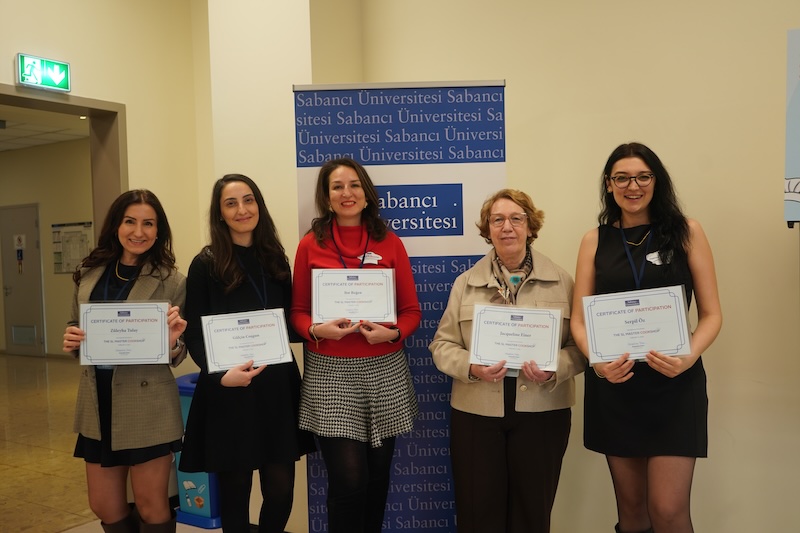
By Jacqueline Einer, Gülçin Coşgun, Itır Beğen, Serpil Öz & Züleyha Tulay
Jacqueline Einer
I will leave the description of the 2026 Master Cookshop to my cofacilitators, Serpil, Gülçin, Züleyha and Itır, who have eloquently recounted the event and shared their insights below. I would instead like to take you back to the inception of the Cookshop. As some of you know, the idea for the Cookshop came to me when I was attending a teaching training forum in 2025. Another attendee made a throwaway line about in-service training not sticking.
This got me thinking about the idea that the training does not really depend on the trainer but the trainee, especially when it comes to in-service training for experienced and qualified teachers. I wanted to find a way to focus more on teachers making choices about the training they need. I think we are living in times when teachers can easily find ways to refresh and update their knowledge about virtually every aspect of teaching, and importantly, teachers are making the most of these opportunities.
Secondly, I wanted to open up space for teachers to share the insights that they gain from the different types of learning they undertake and their classroom experiences and work on them together. This was because I think one of the most important aspects of the act of teaching is the planning of lessons in light of each particular group of students’ individual needs. This is often a very isolated activity, the importance of which can easily be overlooked, and I wanted to shine the light on it. It was also because I believe one of the most powerful ways of learning can be when we are exchanging ideas with colleagues about a task that we are going to put into action in the very near future. So, the idea of The Inaugural SL Cookshop was born.
When I described the idea to the Quality Assurance team, sharing inspirations, challenges, and learning and using these in a collaborative way to plan for upcoming lessons, Andrew Bosson introduced me to the concept of the Unconference. Even though the Cookshop concept is not as unstructured as an unconference, some elements really resonated with what I was aiming to achieve with the Cookshop idea. For example, Duke University, Trinity College of Arts and Sciences described an unconference as a “participant-driven conference model”. It went on to say that “Unconferences subvert the expert-centered structure of traditional conferences by instead prioritizing participant voices …” Joshua Kaufman, an entrepreneur who has facilitated unconferences around the world, developed this idea in an interview in Forbes saying that “... unconferences are all about conversations. … They give participants the opportunity to have an unfiltered exchange of innovative ideas.” He explained that “It’s important to understand innovation as a group process. … The reality of innovation is that we co-create it by feeding off and enabling each other. To be innovators, we need to support each other as we take turns pushing boundaries.”
Conversations which foster unfiltered exchange of innovative ideas that lead to co-creation and mutual enabling is what I wanted to achieve with the inaugural Cookshop that took place in September and in which a number of you took part. My initial conversations with the QA team, my experiences with and the feedback from those of you who participated in the initial Cookshop, along with the ideas of my cofacilitators, led to the Master Cookshop in which around 19 external participants and 13 SL participants collaborated and co-created. Both the creation and the implementation themselves were an illustration of innovation as a group process. My aspiration was realized with the contributions, knowingly and unknowingly, of so many of you. Viva SL!
Serpil Öz
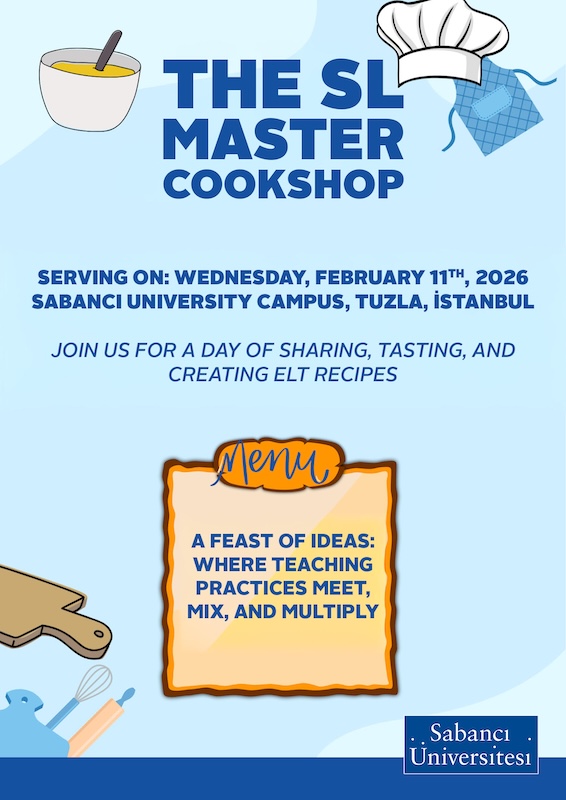
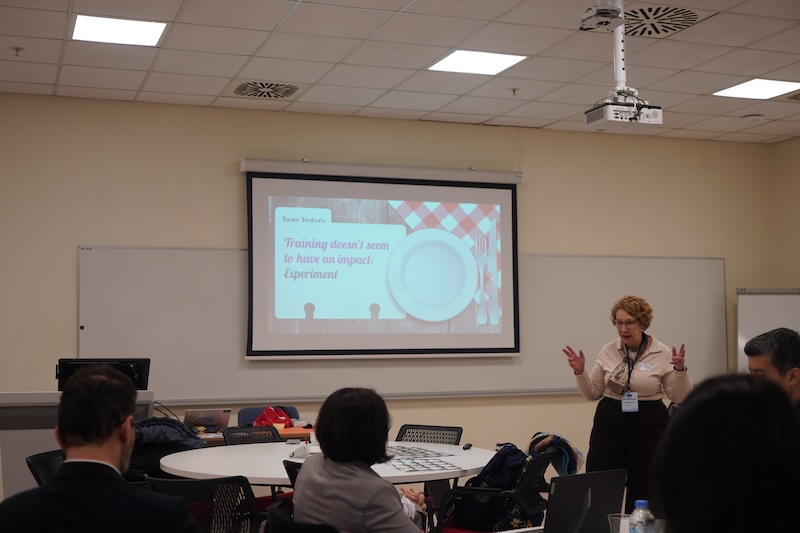
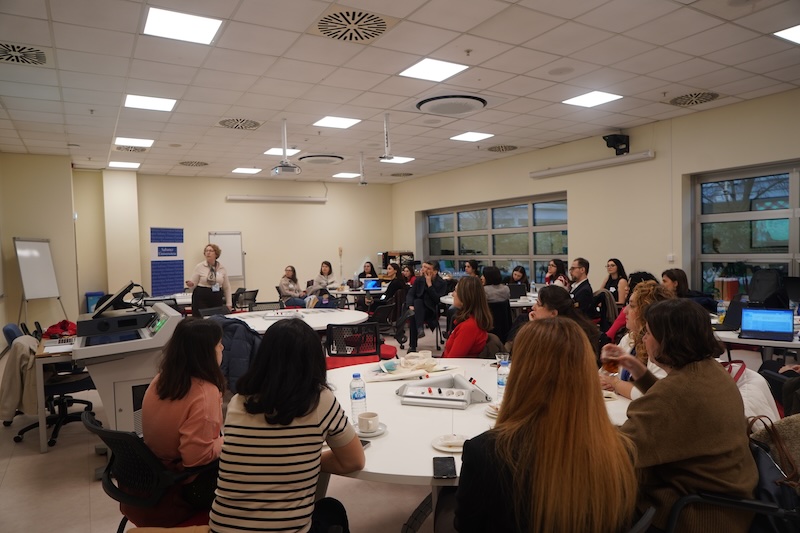
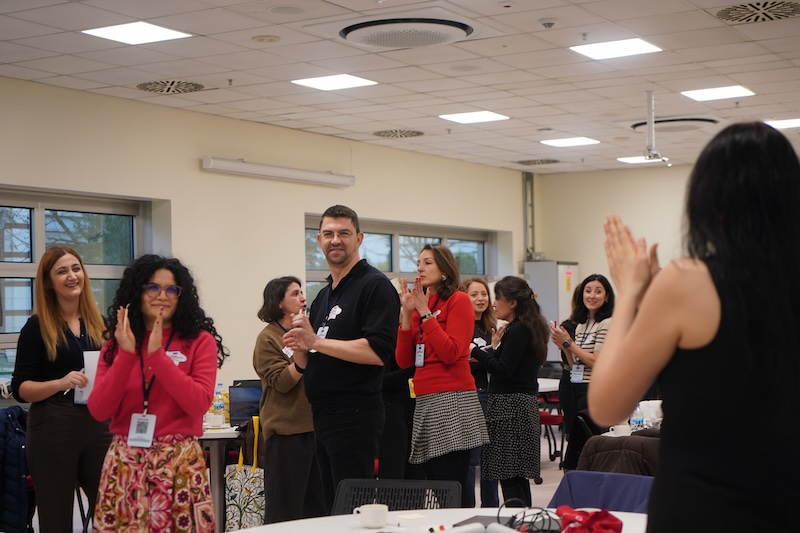
On the 11th of February, we hosted the SL Master Cookshop at Sabancı University School of Languages—a one-day, hands-on professional learning experience that brought together 33 preparatory school instructors from universities across Istanbul.
What made the day particularly meaningful was not only the number of participants but also the diversity in the room. Participants came from different institutions, teaching contexts, student profiles, and program structures. Some were working with foundation-year students, others with mixed-level groups; some in large programs, others in smaller departments. And yet, despite the contextual differences, there was an immediate sense of shared experience: we were all navigating the complex, dynamic, and often demanding realities of classroom life.
The “cookshop” theme was not just symbolic—it shaped the entire flow of the event.
1. Starting with our ingredients: In the morning, we began by exploring what inspires us in our teaching and what challenges we continuously encounter.
2. Choosing one key challenge: Participants then narrowed their focus to one pressing classroom challenge — something real, current, and meaningful.
3. Collaborative cooking: Throughout the day, groups worked on these challenges, designing practical “"recipes"—concrete, adaptable strategies and tools that could be implemented in their own contexts.
4. Sharing and refining: Ideas were shared, questioned, refined, and strengthened through different reflection activities
The emphasis was always on practicality — not abstract theory, but usable solutions grounded in lived classroom realities.
I had the privilege of facilitating the morning session. Together, we created a space where teachers could openly articulate both their inspirations and their struggles. What struck me most was the honesty in the room. Teachers spoke about:
● sustaining student motivation,
● managing mixed-ability classrooms,
● balancing institutional expectations with pedagogical beliefs,
● assessment pressures,
● maintaining their own professional energy.
Rather than rushing to fix these issues, we first allowed ourselves to name them. That act alone felt powerful. From there, participants selected one challenge to carry with them throughout the day — not as a burden, but as a starting point for collaborative inquiry.
One of the most exciting outcomes of the day was the idea of creating a digital recipe book — a shared collection of the strategies, approaches, and reflections developed during the cookshop. This book is more than a compilation of activities. It is:
● A record of real classroom struggles.
● A reminder that none of us are struggling alone.
● A space where solutions are contextual, thoughtful, and adaptable.
● A living resource we can return to whenever we need inspiration or reassurance.
When we revisit it in the future, we will not just see “solutions.” We will see teachers thinking deeply. Questioning. Designing. Collaborating. And that, perhaps, is the most valuable product of all.
All in all, professional development is often associated with listening. This event was about doing. It was about thinking together, building together, and acknowledging that expertise does not sit at the front of the room—it circulates within it.
The SL Master Cookshop reminded me that when teachers are given space, trust, and structure, they produce extraordinary work.
And this time, we even wrote the recipes down. 😊
Gülçin Coşgun
To me, one of the most striking aspects of the Master Cookshop was how practical the entire day felt. In many conferences or training sessions, it is easy to remain in a more passive role as a listener. While those formats can be informative, it is not always easy to put ideas into practice. The Cookshop format, however, placed us right at the centre of the learning process. We were constantly producing, adapting, and reflecting. More importantly, many of the ideas shared were not just theoretical suggestions but techniques and tools that had already been tried and tested in real classrooms. This made it much easier to imagine how we could implement them in our own contexts. Another highlight of the day was the Recipe Book that came out of the Cookshop. Having all the ideas in one place feels really valuable. Instead of leaving the event with incomplete notes or half-remembered activities, we now have something concrete, and we can go back to it whenever we need. We can keep using and adapting the ideas or activities over time. The design actually makes you want to open it and browse through, which isn’t always the case with PD materials 🙂. For me, this turns the Cookshop into more than just a one-day event. It becomes an ongoing resource that can continue to support our teaching long after the day is over.
I also had the opportunity to lead the Exchanging Ideas and Feedback session, which was one of the most rewarding parts of the day for me. Instead of asking participants to give direct feedback on each other’s work, this session was designed to be more purposeful and closer to what we actually do as teachers in real life. I believe this is closer to what we as teachers actually do in real life. So, a simple scenario was used: “You have guests tonight. Your students are coming to your restaurant, and you want to serve them the best possible menu.” In their groups, teachers first read the recipes prepared by others. Then they designed a menu of three “dishes” (activities). They could choose the recipes as they were or adapt them to fit their own students, levels, contexts, and classroom realities. For each dish, they briefly explained why they chose it, how it would meet their students’ needs, and what changes they might make. After that, groups put their menus on posters, and we did a gallery walk. Everyone moved around the room, read the menus, and left post-it notes with feedback: one thing they liked, one idea they found useful, one possible adaptation for their own students, or one question they had about the menu. What I really liked about this part of the day was how naturally feedback happened. Because teachers were choosing recipes for their own “students,” they read each other’s work with genuine interest. The comments were thoughtful, practical, and often very specific. It didn’t feel like giving feedback for the sake of it. Actually, it felt like borrowing ideas for real classrooms. Teachers were not just evaluating ideas but were already thinking about how they would use or adapt them in their own contexts.
Itır Beğen
The Master Cookshop was structured in a way that prioritized active participation rather than passive listening. Instead of ideas being presented for later interpretation, activities were produced, adapted, and discussed collaboratively. The format required engagement with pedagogical decisions in real time, making the reasoning behind classroom practices more visible.
The cookshop metaphor functioned as an organizing framework. Recipes were treated as adaptable lesson plans, ingredients as teaching tools, and tasting as reflection. Emphasis was placed on modification according to context rather than replication. This approach highlighted the importance of professional judgment when transferring ideas into different classroom environments.
An important outcome of the day was the development of the Recipe Book. Rather than leaving with fragmented notes, participants contributed to a shared resource that documents activities alongside their rationale and possible adaptations. This allows the insights generated during the event to remain accessible and usable beyond a single session.
The feedback process was also structured around application. Activities were examined through the lens of specific student needs, levels, and constraints. Feedback was therefore framed in terms of implementation and adjustment rather than evaluation alone.
Overall, the Cookshop model demonstrated that professional development can be strengthened when structure, collaboration, and continuity are integrated. When teaching practices are co-constructed, analyzed, and documented collectively, professional learning is more likely to extend into sustained classroom practice.
Züleyha Tulay
Organizing the SL Master Cookshop was, in many ways, an act of professional faith. You design the structure, curate the conditions, and trust that when teachers are brought into the same room with space to think and something worth working on, something meaningful will happen.
From where I stood, both as an organizer and as a facilitator, what I witnessed throughout the day was something that professional development events don't always manage to produce: genuine engagement. One of the moments that stayed with me was during the recipe-building phase. Moving between groups, I paused at the tables where teachers from different institutions, with completely different student profiles, were deep in a discussion about whether a particular strategy would land better at a particular level. They were building something together and refining it. That, for me, was the cookshop working exactly as we had hoped.
From the early planning stages, it was important to us that participants left with something tangible: a resource they had genuinely contributed to, not a handout they had merely received. Seeing the finished book, full of real strategies born from real classroom challenges, reminded me why this kind of collaborative professional development matters. It is not just about the day itself. It is about what the day leaves behind.
If I had to name one thing the Master Cookshop confirmed for me professionally, it would be this: teachers, when trusted, are extraordinarily generous with their expertise. They share it, shape it, and hand it on. All we needed to do was set the table—and if you'd like to see what our guests cooked up, the Recipe Book is right here, waiting to be browsed.