From Insight to Practice: Highlights from Eaquals 2026
From Insight to Practice: Highlights from Eaquals 2026
by Gülçin Coşgun, Kassandra Robertson & Tuğba Yıldırım Kumbasar
Between 12-14 March 2026, we attended the Eaquals International Conference in Berlin, an event that brought together language teaching professionals, researchers, and institutional leaders from around the world. The conference explored a wide range of themes, including innovations in language education, best practices in teaching and learning, course and curriculum design, the CEFR and assessment, continuing professional development, and effective leadership and management; and sessions delivered fresh insights from experienced practitioners, alongside concrete tools and strategies that can be directly implemented in various educational contexts. Especially valuable were the opportunities to connect with peers, exchange ideas, and reflect on shared challenges. Here we offer an overview of our experiences at the conference, focusing on selected sessions, key takeaways, and reflections on how these ideas might inform classroom practice and approaches to language education.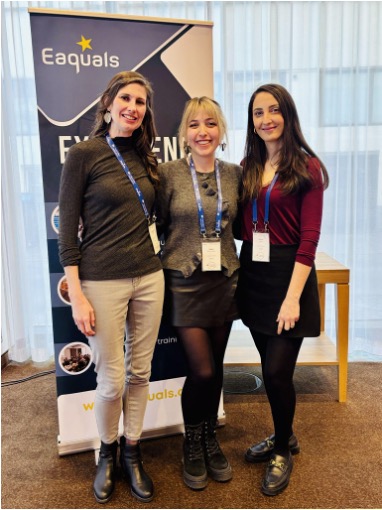 This year’s pre-conference Management Training Day focused on AI integration through a series of sessions facilitated by Beatrice Segura Harvey of ELT Specialist. The first, centered on the development of effective institutional AI policies, offered an overview of several key areas including ethical use, AI literacy, the GDPR and EU AI Act as regulatory frameworks, safeguarding, and assessment. Harvey advocated for a risk-based approach over a ‘blanket ban’, with particular caution to high-stakes uses like grading, admissions, and placement. Addressing assessment and academic integrity, Harvey highlighted the need to align AI use with pedagogical goals while mitigating risks such as cognitive offloading, by incorporating clearly defined permitted uses, prohibited uses (e.g., submitting student data to external tools), discouraged uses, and specified conditions of use, such as mandatory disclosure. She concluded by presenting a practical ‘7-point’ policy template which consisted of: (1) Scope and Purpose, (2) Definitions and Key Terms, (3) Roles and Responsibilities, (4) Acceptable Use Guidelines, (5) Disclosure Expectations, (6) Data Handling and Copyright, and (7) Monitoring and Review. With respect to communication, her recommendations included embedding policies into onboarding processes, revisiting them in regular meetings, and designating institutional points of contact for AI-related matters. In developing their own policies, participants were encouraged to prioritize data privacy, maintain human oversight, and build trust through transparency and, critically, ongoing training, which Harvey emphasized as ‘essential’ to effective AI integration.
The second session extended this discussion by situating AI capability within the Eaquals Academic Management Competency Framework (AMCF), demonstrating how digital transformation can support core areas of academic management. Through a series of case studies, Harvey demonstrated how ‘light-touch’ AI can be used to enhance professional development, streamline planning and administration, support resource and change management, and strengthen quality assurance as well as curriculum design. A particularly noteworthy tool demonstrated during this session was n8n, a workflow automation tool used to illustrate an optimized process for reporting attendance. Harvey’s guidance for implementation centered on four fundamental principles: organizing data effectively, remaining attentive to risk, identifying where human input is essential, and adopting an iterative approach to innovation. The final session provided a hands-on opportunity to apply these ideas, as participants worked collaboratively in small groups each focused on one of four AI-related areas: developing an institutional AI policy, optimizing workflows, analyzing assessment data, or developing a CPD plan. This combination of strategic framing and practical application made the day particularly valuable, offering both a clear framework for AI integration and a range of adaptable ideas for diverse institutional contexts.
The opening plenary “Plurilingualism: from theory to practice, from practice to policy” by Professor David Little highlighted the concept of plurilingualism and its implications for language education. One of the key ideas was that learners’ different languages should not be seen as separate systems but as interconnected resources that contribute to a single communicative repertoire. This perspective challenges the traditional monolingual approach in language classrooms, instead encouraging teachers to value and use students’ full linguistic backgrounds as part of the learning process. Particularly interesting were the classroom examples demonstrating how students’ ‘home languages’ can actively support learning, being used for peer communication, collaborative work, and even for displaying knowledge in the classroom. These practices showed that allowing learners to draw on their entire linguistic repertoire can enhance engagement and deepen understanding. Moreover, the examples suggested that such practices can lead to greater metalinguistic awareness, as students become more conscious of how languages relate to each other. Another important point was the connection between classroom practice and language education policy. The talk emphasized that plurilingual approaches should not remain theoretical ideals but rather be reflected in educational policies that recognize and support linguistic diversity in schools. This highlighted the need for alignment between what research suggests, what teachers do in classrooms, and what policies promote. Overall, the plenary encouraged a shift in perspective suggesting that we need to move from viewing multiple languages as a challenge to seeing them as an asset for learning. It also encouraged reflection on how teachers can create classroom environments where students’ linguistic resources are acknowledged and used meaningfully to support both language development and broader learning.
“The Feedback Stage: Turning Post-Task Time into Learning Time” by William Morrow focused on reconsidering the role of feedback in language classrooms. The speaker argued that in many lessons the feedback stage becomes a quick procedural step where teachers correct errors while students passively listen. As a result, valuable learning opportunities are often missed. The session proposed that post-task feedback should instead function as an interactive stage that actively promotes learner engagement and reflection. A key concept discussed was the importance of noticing, drawing on the Noticing Hypothesis. According to this idea, learners acquire language more effectively when they consciously notice features of language. Therefore, feedback should help learners identify gaps in their language use, reflect on them, and reformulate their output. Morrow also emphasized that feedback can serve several purposes, such as recycling language, building awareness, and preparing learners for the next task. One of the most useful aspects of the session was the presentation of three practical models that make feedback more interactive. The ‘Discovery Board’ encourages guided discovery by asking students to categorize and correct collected learner sentences. The ‘Reformulation Loop’ involves the teacher reformulating learner language and asking students to discuss why the reformulated version is more effective. Finally, the ‘Feedback Gallery’ turns feedback into a collaborative activity where students move around the classroom, discuss language errors, and correct them in pairs or groups. These activities are simple to implement and require minimal preparation. Overall, the session highlighted the potential of feedback as a learning stage rather than a correction stage. It encouraged teachers to reduce teacher talk time and create opportunities for students to actively analyse language. This perspective underscored the importance of designing feedback more deliberately so that learners notice patterns, engage with language more deeply, and take greater responsibility for their learning.
In “AI in Language Education: From Classroom Practice to Institutional Implementation”, Nazlı Deniz Barutçuoğlu, PhD of MEF University presented a framework for integrating generative AI into English language programmes at both classroom and institutional levels, which was both practical and clearly grounded in classroom reality. Her talk focused on how AI can support, rather than replace, students’ thinking processes, a perspective that closely aligns with current discussions in our own context. She introduced a three-stage model which consisted of: AI-free learning, where students construct knowledge through individual reflection and discussion; AI-enhanced learning, where they critically compare and evaluate AI-generated outputs; and prompt literacy and reflection, which develops learners’ skills in prompt design, output evaluation, and responsible AI use. A practical task example illustrated this progression, moving students from individual reflection on a pre-class video to pair-work and finally to whole-class synthesis; and it was useful to see how adaptable this structure could be across different teaching contexts. She further emphasized that this approach can help guard against over-reliance while at the same time fostering critical AI literacy, strengthening academic integrity, and promoting deeper engagement with language. Underlying these outcomes were several key principles, including beginning with pedagogy rather than tools, sequencing AI use intentionally, embedding reflection throughout learning tasks, carefully scaffolding activities, and supporting teachers through shared institutional frameworks. These ideas resonated strongly, as they closely align with approaches already valued and actively integrated into our own practices.
The final afternoon of the conference featured an impressive selection of hands-on workshops. An exceptionally interactive and illuminating session called “Socrates in your pocket: Teaching students to be critical thinkers” came from Robin Kosseff, Coordinator of the Writing and Speaking Center also at MEF University, which focused on the classic art of questioning to guide learning. Participants examined the distinction between inductive and deductive reasoning in relation to various learning scenarios and challenged to consider the impact of this on their teaching approach. After then reviewing the various question types associated with Socratic questioning, participants engaged in an invigorating ‘fishbowl’ exercise in small groups, where select members discussed a text they had read using only their assigned question type (e.g., concepts and ideas, viewpoints and perspectives, and implications and consequences), while the others quietly looked on and later shared their observations. You might say it raised more questions than it answered, as the exercise gave way to a compelling discussion among participants sharing their experiences and considering how such an activity might be adapted for various language education contexts, student profiles, and learning outcomes.
Overall, the conference offered a valuable opportunity to engage with current developments in language education while reflecting on their practical implications for our own context. Across sessions, the importance of aligning pedagogical principles with institutional values, evolving tools, and learner needs emerged as a recurrent theme. Equally important was an emphasis on collaboration, across roles, disciplines, and institutions, as a means of strengthening both teaching practice and professional development. Our experiences taking part in this meaningful event provided not only an abundance of strategies but perspectives enriched with the latest ideas and best practices in language education.