
The ICOS 2026 Conference — the International Conference on Organizational Sociology
The ICOS 2026 Conference — the International Conference on Organizational Sociology
by Ozan Tekin
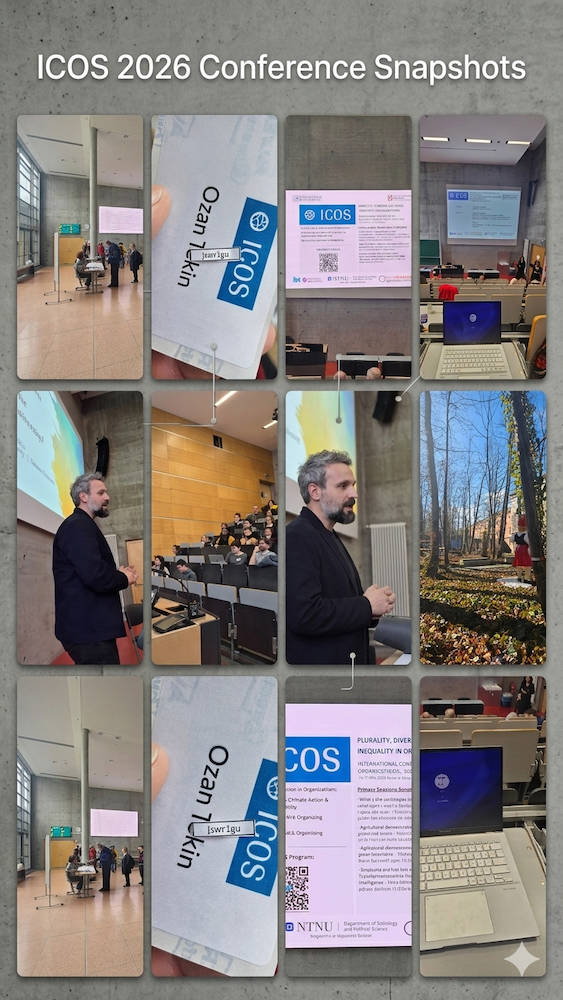
In early September, we came across a timely opportunity to apply for the ICOS 2026 Conference — the International Conference on Organizational Sociology — taking place in Potsdam, Germany on 16–17 March, under the theme Plurality, Diversity and Social Inequality in Organizations. The conference brought together scholars grappling with how organizations respond to rapid and profound transformations, from sustainability and digital governance to generative AI. It felt like exactly the right room for what we had been thinking about. Together with my colleague Ayça Yılmaz from Turkish-German University, we decided to explore a topic that is both very dear and close to us. One we have been pondering upon for a long time, not only in the context of our academic lives but also in the broader social and structural conditions incumbent on our own personal lives.
The neoliberal transformation of the university has been ongoing for decades and has been increasingly instrumentalized through quantification. Article counts reduce complex research trajectories to a raw frequency of publication. Conference attendance is tallied as a measurable record of networking rather than genuine scholarly exchange. Citation indices and H-indices surrogate for the actual depth or social utility of an argument. What these measures share is that they do not simply miss the nuance of intellectual work; they actively distort it by incentivizing volume over veracity. In this sense, metricization is not a neutral administrative tool but a form of epistemic violence imposed on scholarly life. What gets lost in this process is something harder to name but easy to feel. Academic work is, at its core, a slow methodology. It requires time for reflection, the willingness to fail, and the silence necessary for synthesis. It demands the autonomy and freedom to deliberate, to collaborate, and to think critically through painful and long hours of working through the night. All of this has been temporally and spatially compressed into almost a millisecond. This, we have felt, has been causing many academicians all over the world to be alienated from their own work.
For scholars in Turkey, this alienation carries an additional weight. The collision between the drive for internationally metricized excellence and the local struggle for critical autonomy creates a specific site of tension, where the very foundation of the discipline , which is freedom of thought, is constantly weighed against the demands of a quantified global ranking system.
And yet, what compelled us most to bring this to Potsdam was a paradox we had both been quietly sitting with. The emergence of AI tools in academic life does not merely function as an assistant; it offers, in many cases, a bypass of the intellectual process itself. When the struggle of argumentation is replaced by predictive text, something essential disappears. The long hours of working through a difficult idea, which are not a symptom of inefficiency but the very substance of scholarship, get reframed as a problem to be solved. And when that happens, what remains of freedom of thought, critical thinking, argumentation, and deliberation? aradoxically, our own engagement with AI has not felt like estrangement. If anything, it has pushed us back toward these very foundations, sharpening our awareness of what is at stake and deepening our relationship with academic work rather than severing it.
This is the tension we took to Potsdam and one we believe deserves an honest, open conversation. We would love to hear from colleagues too. Has the neoliberal transformation of academic work left you feeling alienated too, and has AI, paradoxically, brought you back to it in any way?