
Reflections from UNESCO Digital Week 2025: Disruption, Dilemmas, and Directions

Reflections from UNESCO Digital Week 2025: Disruption, Dilemmas, and Directions
By Ozlem Zengin
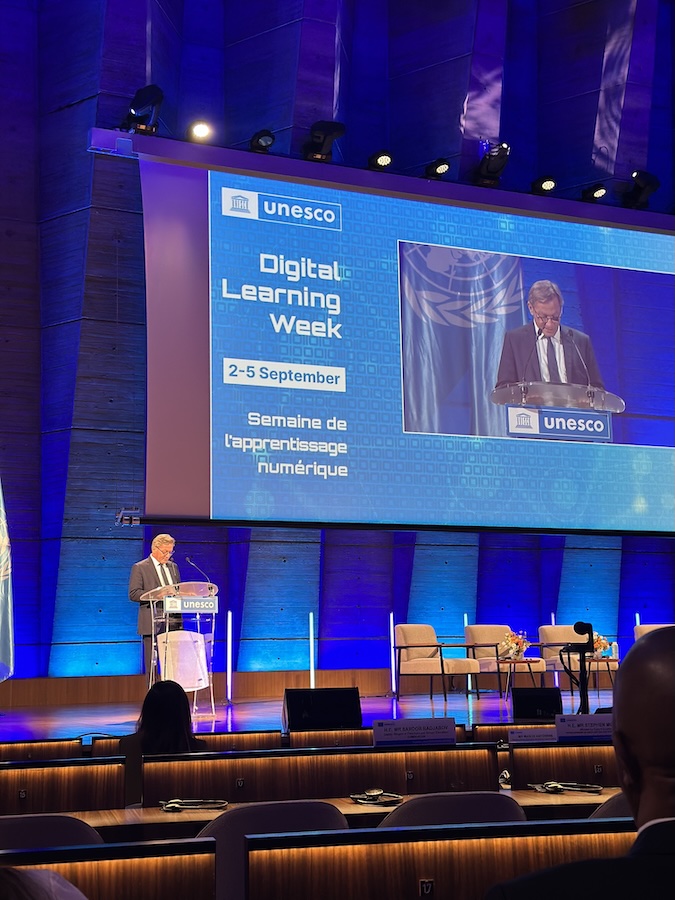
Earlier this week, I had the privilege of attending UNESCO Digital Week 2025 in Paris, held on 2–3 September under the theme “Disruption, Dilemmas, and Directions.” The conference brought together policymakers, ministers, academics, and international organizations to reflect on how artificial intelligence (AI) is transforming education worldwide. For me, it was both inspiring and thought-provoking, as the sessions raised big questions about the role of teachers, learners, and institutions in a rapidly changing digital era.
AI as Both Opportunity and Disruption
The event opened with a vision talk by Stefania Giannini, UNESCO’s Assistant Director-General for Education, who captured the central tension of the conference: AI is an extraordinary opportunity, but it is also a disruptive force that raises ethical, human, and policy dilemmas. She outlined five guiding directions that should shape education systems moving forward:
• Sustainable digital infrastructure must be prioritized.
• Safety and ethics are non-negotiable.
• Teachers are irreplaceable.
• “AI for all” must truly mean all, respecting cultural and linguistic diversity.
• Global solidarity is essential, since no country can navigate this transition alone.
Her words set the tone for the two days: AI is not something we can ignore, but neither should we accept it uncritically.
Inclusion, Equity, and the Human Dimension
One of the most powerful sessions for me was the forum on children with disabilities and refugee learners. Speakers from UNICEF, ITU, and UNHCR emphasized that AI must serve all learners equally. If designed responsibly, AI could unlock opportunities for children who are often excluded from traditional education systems. But if neglected, it could deepen inequalities. This session reminded me that inclusion must be at the heart of any AI strategy.
Equally striking was the contribution from Professor Emily Bender, who reminded us that large language models only mimic human reasoning without truly understanding. Her message was clear: education leaders are not compelled to adopt AI tools simply because they exist—we need to evaluate them critically and thoughtfully.
Rethinking Learning in the AI Era
The plenary on “The New Grammar of Learning” addressed how AI is reshaping curriculum, pedagogy, and assessment. From adaptive platforms to generative tools, AI is rewriting the rules of education. But the panelists—ranging from ministers of education to researchers—kept returning to the same question: How do we ensure these changes enhance human creativity, judgment, and ethics, rather than replacing them?
On the second day, philosopher Bayo Akomolafe invited us to pause and rethink the assumptions behind AI-driven education. Instead of focusing only on speed and efficiency, he asked us to consider how education can remain deeply human in a world increasingly influenced by algorithms. His call to “unframe and reframe” education resonated strongly with me.
Higher Education, Ethics, and Teacher Agency
Several sessions focused on higher education and the institutional responses to AI. Universities around the world are grappling with how to integrate AI responsibly, from policies on academic integrity to building AI literacy among staff and students. Türkiye was represented by Mustafa Canlı from the Ministry of National Education, who shared national perspectives on the opportunities and challenges ahead.
The conference closed with a strong emphasis on teacher agency. As highlighted in UNESCO’s recent work, AI should support—not replace—teachers. Professional development, ethical guidance, and capacity-building are essential if educators are to lead the digital transformation rather than be sidelined by it.
My Takeaways
Attending this conference made it clear that AI in education is not just about tools or technology. It is about values, ethics, and human choices. For me, three takeaways stand out:
1. Teachers must remain at the center. AI can enrich teaching, but it should never replace the human relationships that make learning meaningful.
2. Equity is essential. From refugee children to students with disabilities, AI strategies must include everyone.
3. Institutions need clear strategies. Policies should balance innovation with responsibility, ensuring AI is used critically and ethically.
Closing Thoughts
UNESCO Digital Week 2025 left me with a renewed sense of responsibility. AI is here to stay, but how we use it in education is still up to us. If guided by ethics, inclusion, and human-centered values, AI can help us reimagine education for the better. If not, it risks widening divides and eroding the very foundations of learning.
As I return to my own institutional context, I carry with me not only insights but also a strong conviction: the future of education in the age of AI must be built collectively, responsibly, and with teachers and learners at its heart.
Infographic-Digital Learning Week UNESCO by Özlem Zengin: Please click here