
Turning Worlds Upside Down
 Turning Worlds Upside Down:
Reflections from ESA RN15 Mid-Term Conference in Split: Global Sociology in Transformation
by
Ozan Tekin
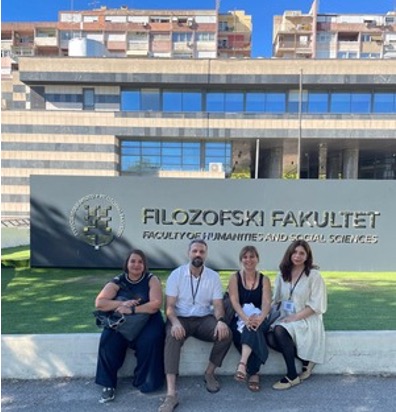
Between 17-19 September I had the chance to co-present a paper titled ‘’ The Intersection of Polarization, AI and Universities in Turkey’’ with Associate Professor Ayça Yılmaz at the ESA RN15 Mid-Term Conference in Split, Croatia. The conference theme — Global, Transnational, and Cosmopolitan Sociology — offered fertile ground for thinking about the place of sociology in a world marked by political polarization, global crises, and shifting intellectual landscapes. Among the most inspiring and thought-provoking sessions was Geoffrey Pleyers's keynote. His presentation challenged us to reconsider the very foundations of sociology as a discipline and opened up pressing questions about its Eurocentrism, global relevance, and future directions.
Is Sociology in Crisis?
Pleyers began with a provocative question: Is sociology in crisis? He outlined critiques that many of us grapple with, including its persistent Eurocentrism and the colonial legacy embedded in the discipline, the false claim of universality in Western sociology which often masks exclusionary practices, and its androcentric bias that marginalizes alternative voices and epistemologies. These critiques lead to a central dilemma: Is global sociology still possible after the decolonial criticism?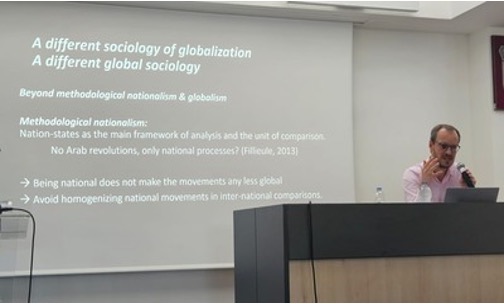 Drawing on scholars like Margaret Archer, TK Oommen, and Immanuel Wallerstein, Pleyers argued that sociology must be "turned upside down" — from Americanization to genuine internationalization, from Eurocentric analysis to Global South epistemologies, from universalized theories to regional dialogues. This call resonates with long-standing efforts to reconsider sociology as a truly global conversation, which resonates with my teaching context: where students often rely on Anglo-American scholarship. Encouraging them to read, cite, and critically engage with perspectives from beyond the West not only diversifies their bibliographies but also equips them with a deeper understanding of power in knowledge production.
Post-Western Sociology
The idea of Post-Western Sociology, as described by Laurence Roulleau-Berger and Li Peilin, further underscored this point. Quoting Li Yumei: "Post-Western Sociology is an approach, more than something that comes after or against Western Sociology. If taken seriously, it does not only give a space to Chinese, Korean, and Japanese sociology in global sociology, it transforms sociology."
In my classes, this aligns with discussions about voice in academic writing. Just as sociology must transform when more voices are taken seriously, student writing changes when learners see their own voices (shaped by diverse linguistic and cultural backgrounds) as part of academic discourse rather than marginal to it. Another key intervention was Pleyers's critique of what Raewyn Connell once called "theories in the North, fieldwork in the South." He pointed to how global scholarship often relies on Eurocentric theories and analyses, the universalization of Western cases, and a "global audience" shaped by elite institutions and media, rather than local communities. This results in knowledge extractivism, where the South provides raw data while the North monopolizes theory-making. As Pleyers asked: Who do we write for? Where do we publish? How do we publish? These are exactly the kinds of questions I ask students when we talk about writing for an audience, situating arguments, and reflecting on the ethics of citation. In an age where generative AI can reproduce dominant voices at scale, these concerns become even more urgent — students must learn to question not only what they read, but whose perspectives are absent.
Pleyers framed these debates within the decolonial turn in sociology. This turn requires questioning inherited Eurocentric worldviews while opening dialogues for a renewed global sociology. He emphasized that dialogue — not rupture — should guide this process, creating space for plural perspectives while holding on to sociology's critical vocation. In his conclusion, Pleyers encouraged us to think beyond methodological nationalism as well as methodological globalism. Using the Arab revolutions as an example, he showed how framing events strictly as "national processes" or homogenizing them as "global trends" misses their complex realities. Instead, he argued, we need a sociology that recognizes national movements as part of global dynamics, an approach that avoids flattening differences across contexts, and a commitment to comparative work that respects multiplicity.
 Global Novels, Global Readers
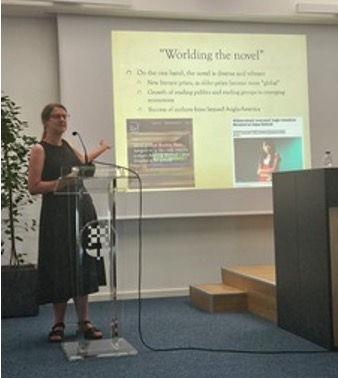
While Pleyers interrogated sociology's global futures, Dr. Elsje Fourie from Maastricht University approached the question of "global" from another angle: literature. Her talk, "Global Novels, Global Readers? Transnational Literary Circuits and the Affective Imaginaries of Reading Together," examined how novels travel across borders and what it means to read "globally." She introduced the idea of "worlding the novel," noting that on one hand, the novel is increasingly diverse and vibrant, with new literary prizes emerging, older prizes becoming more "global," reading publics growing in emerging economies, and authors from beyond Anglo-America finding new recognition and audiences. Yet this worlding is not straightforward, involving both opportunities for broader circulation and persistent inequalities in who gets translated, published, and awarded.
The idea of reading together across difference particularly resonated with me. In my courses, collaborative reading and peer review sessions already create microcosms of this practice. Students with different backgrounds bring unique interpretations to the same text, showing that reading is never neutral but always situated. What struck me most was Fourie's emphasis on the affective imaginaries of reading. Global novels do not only circulate as commodities; they also invite us to imagine new forms of connection across difference. Reading together, even across continents, can generate shared affective worlds despite their fragilty or uneven distribution. Her intervention resonated deeply with the broader conference theme: just as sociology must move beyond Eurocentrism to embrace plural voices, so too must literature be understood as a site where global circuits, inequalities, and solidarities intersect. Both talks reminded me that teaching academic writing is not only about skills but also about cultivating critical global literacy. When we ask students to engage with scholarship critically, we are teaching them to see beyond the "universal" claims of dominant traditions. When we integrate non-Western perspectives into reading lists, we are enacting, on a small scale, the call for post-Western sociology. When students use AI tools, I frame it as an opportunity to question the biases embedded in these technologies, much like sociologists question Eurocentrism in their discipline. Listening to Geoffrey Pleyers and Elsje Fourie in Split, I realized how closely their concerns intersect with my own teaching. Whether in sociology or in literature, the task is the same: to recognize diversity without flattening it, to resist extractivism while fostering dialogue, and to imagine new forms of connection across borders. As I return to my own students (many of whom are preparing to write research papers, engage with AI tools, and enter transnational academic spaces) I believe that teaching academic writing is itself a form of global sociology: a practice of dialogue, critique, and imagination that equips the next generation not only to consume knowledge but to transform it. The richness of these conversations and insights will continue to inform our work, as the paper Associate Professor Ayça Yılmaz and I presented will develop into an academic article, strengthened by the invaluable contributions and perspectives we gathered during this transformative conference experience.