
Reflection on Rachel Jeffries’ EAQUALS Presentation: “From Awareness to Engagement – Building Skills and Resilience to Engage with Sustainability Challenges”
Reflection on Rachel Jeffries’ EAQUALS Presentation: “From Awareness to Engagement – Building Skills and Resilience to Engage with Sustainability Challenges”
by Ceyda Gümüş and Özlem Yanar
Rachel Jeffries’ presentation, delivered via Zoom on October 11, 2025, as part of the EAQUALS Online conference, offered a compelling and practical exploration of how educators can engage with sustainability through the lens of the Cambridge Sustainability Framework for ELT. The session was attended by a diverse group of teachers from across Europe, including Spain, Portugal, Italy, and Turkey, representing various educational levels—from pre-primary to university.
The session built upon a previous introduction to the framework and transitioned into a more practical application. Jeffries acknowledged the time constraints faced by educators and positioned the session as a means to integrate sustainability into existing materials, rather than requiring the adoption of entirely new resources. She showcased examples from Shining Lights, a newly developed Cambridge course designed with sustainability as a central pillar. Importantly, she stressed that the strategies discussed could be applied to any teaching materials, including those created by teachers themselves.
A key theme throughout the session was the need to cultivate in learners a renewed appreciation for the world, alongside a resilient and hopeful mindset. Jeffries invited participants to reflect on which of these dimensions—appreciation, resilience, or hope—felt most urgent in their current teaching contexts. The emphasis on resilience resonated strongly with many attendees particularly in light of contemporary global challenges.
The presentation also introduced the two core dimensions of the Cambridge Sustainability Framework: Knowledge and Values. These dimensions serve as foundational pillars for engaging meaningfully with sustainability. Jeffries highlighted that effective change requires not only awareness of environmental, social, and economic issues, but also an understanding of their interconnectedness. Without this holistic perspective, interventions may be ineffective or lead to unintended consequences.
Knowledge
The Knowledge dimension focuses on developing a deep understanding of sustainability issues and their systemic nature. The Values dimension emphasizes empathy, care for others and the planet, and the cultivation of attitudes that support long-term engagement. Jeffries underscored the importance of recognizing how values and beliefs influence behavior, particularly when aiming to inspire change in others. It reinforced the idea that fostering resilience, hope, and a sense of global responsibility in learners is not only possible but essential in today’s educational landscape.
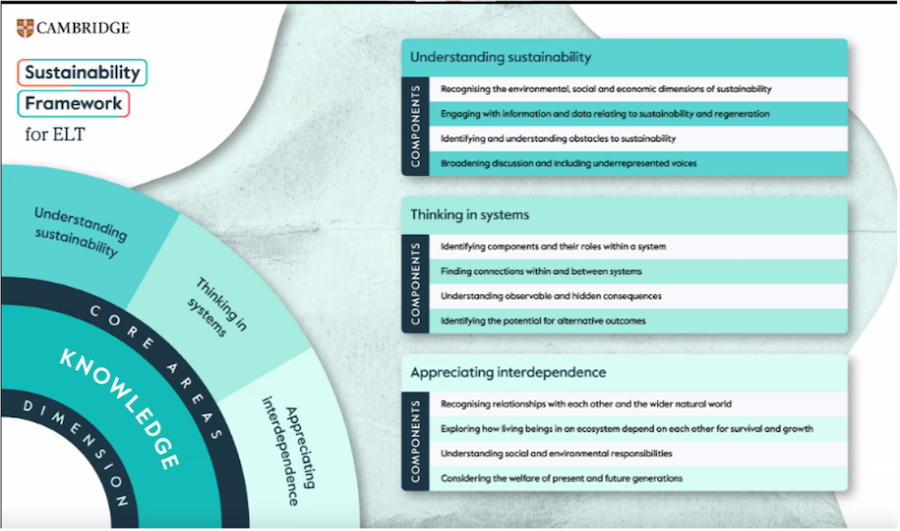
The Knowledge dimension encompasses three core areas:
1. Understanding sustainability,
2. Thinking in systems, and
3. Appreciating interdependence.
Jeffries encouraged educators to begin with foundational classroom activities that prompt learners to observe, question, and reflect. For example, using a simple image from the Shining Lights course, learners were asked to describe what they saw, interpret the context, and consider broader questions such as: Where does this come from? Who made it? Why and how was it made? These questions serve as entry points for exploring the environmental, social, and economic dimensions of sustainability.
The activity also highlighted the importance of appreciating interdependence, which involves:
• Recognizing relationships among individuals and the wider world,
• Exploring ecological dependencies,
• Understanding social and environmental responsibilities, and
• Considering the welfare of present and future generations.
Jeffries noted that learners—and educators—often approach issues in isolation, mirroring the compartmentalization seen in school subjects and professional roles. She argued that fostering systems thinking and interconnectedness is essential for developing effective sustainability solutions.
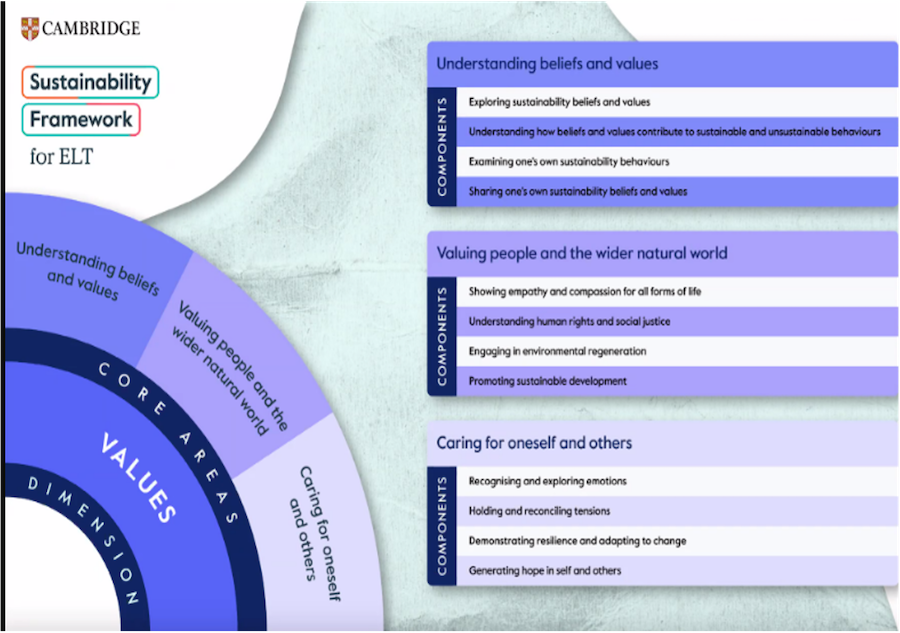
Values Dimension: Cultivating Empathy and Responsibility
The Values dimension encourages learners to:
• Care for nature, people, and future generations,
• Demonstrate resilience and hope,
• Reflect on personal and societal values, and
• Understand how beliefs influence behavior.
Jeffries emphasized that sustainability education is not solely about environmental awareness but also about ethical engagement and emotional resilience. The goal is to nurture learners who are not only informed but also motivated to act responsibly and compassionately.
Pedagogical Considerations and Classroom Adaptation
A recurring theme in the session was the adaptability of activities to diverse classroom contexts. Jeffries acknowledged the wide range of class sizes and educational settings represented by attendees—from small groups to lecture-style classes of 80 students. She encouraged teachers to modify activities to suit their learners’ needs, whether through whole-class discussions or small group work. The example activity, though designed for young learners, was shown to be equally effective with teenagers. It served as a starter for deeper discussions, allowing learners to explore sustainability through multiple lenses. Participants were invited to reflect on which components of the Knowledge dimension were being practiced, with many identifying the recognition of environmental, social, and economic aspects as central.
Jeffries’ session provided a rich demonstration of how sustainability education can be embedded into English language teaching through critical thinking, debate, and values-based inquiry. Using the example of e-scooters, she guided participants through a scaffolded activity that encouraged learners to examine sustainability from multiple perspectives—environmental, social, and economic. Jeffries highlighted that while students may naturally consider environmental impacts in the example of using e-scooters, they often require explicit guidance to explore social and economic dimensions. This activity thus exemplifies how educators can spot opportunities within existing materials to foster systems thinking and interdisciplinary awareness.
Values Dimension: Engaging with Beliefs and Behaviors
Transitioning to the Values dimension, Jeffries introduced a short article titled “Why Animals Laugh and Make Friends”, accompanied by visuals. This text served as a springboard for the exploration of empathy, community, and ethical responsibility—key components of sustainability values.
Jeffries proposed an activity where students examine the social behaviors of animals as a metaphor for human relationships and community-building. This approach allows learners to connect emotionally with sustainability themes, fostering a sense of care for the natural world and for others. Importantly, Jeffries reminded educators that they need not always provide definitive answers. Instead, teachers can empower students to conduct research, fact-check, and teach one another, reinforcing the idea that sustainability education is a collaborative and evolving process.
Jeffries’ presentation exemplifies how sustainability can be meaningfully integrated into ELT through visual prompts, critical questioning, debate, and values-based reflection. By leveraging the Cambridge Sustainability Framework, educators can guide learners to develop both the knowledge and emotional resilience needed to engage with global challenges. The session reinforced the importance of adaptability, student agency, and interdisciplinary thinking in fostering a generation of informed and compassionate change-makers.