
Sustainability Framework in ELT: A Reflection on Rachel Jeffries’ “From Awareness to Engagement – Building Skills and Resilience to Engage with Sustainability Challenges”

Sustainability Framework in ELT: A Reflection on Rachel Jeffries’ “From Awareness to Engagement – Building Skills and Resilience to Engage with Sustainability Challenges”
By Levent Çoban
I would like to reflect on one particular session that I attended at this year’s EAQUALS Online Event. Rachel Jeffries delivered a presentation on Cambridge’s Sustainability Framework in ELT.
I found this session both intriguing and eye-opening because, when we hear the word sustainability, we usually think of environmental issues. Of course, individuals who are aware of environmental problems and act responsibly make a great contribution to our world. However, focusing only on the environment limits our understanding of what sustainability really means. This is especially true for us, language teachers.
We know that language teaching is not only about helping students communicate, but also about educating global citizens who can think critically, understand different perspectives, and show respect for others and other cultures. Therefore, the Sustainability Framework in ELT provides an important opportunity for teachers and learners to reflect on our broader responsibilities as educators. I personally felt encouraged to see that teaching English can also contribute to developing empathy, awareness, and responsibility among learners, not just linguistic skills.
As Cambridge University Press & Assessment (n.d.) explains, sustainability involves three interconnected dimensions — environmental, social, and economic. Environmental sustainability focuses on protecting ecosystems and natural resources; social sustainability aims to build fair and healthy communities; and economic sustainability ensures that economic activity benefits both people and the planet.
The Sustainability Framework in ELT is organized into four core dimensions: knowledge, values, innovation, and transformation. Each dimension has its own objectives and components that help teachers integrate sustainability into classroom practices. I found this structure quite useful since it gives us a clear direction and provides a roadmap for us, teachers. Below, the first visual shows a general overview of the framework. The second visual shows how each “dimension” is achieved through objective components:
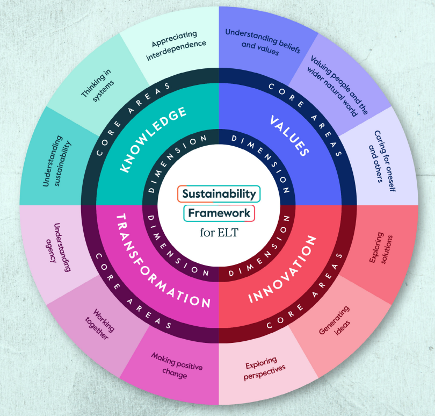
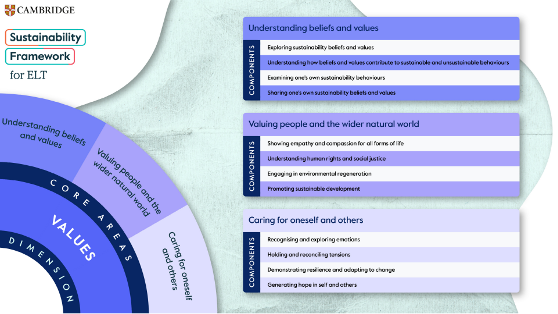
Jeffries started their presentation by introducing the framework. After introducing this framework, Jeffries shared some classroom activities mainly related to the “knowledge” and “values” dimensions. They began with an example from a coursebook unit showing an advertisement for an electric scooter. Learners first described what they saw in the ad using simple WH- questions. This helped them engage with the topic before exploring it in more depth:
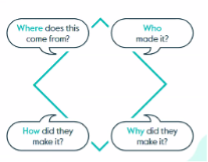
Later, Jeffries introduced that the students were actually working through the “knowledge” component of the framework as can be seen below:
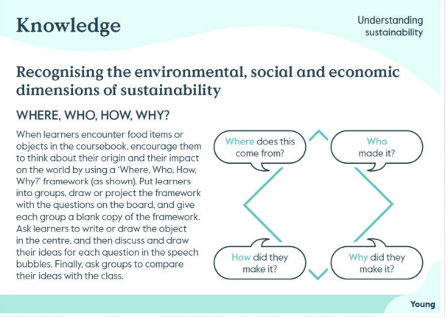
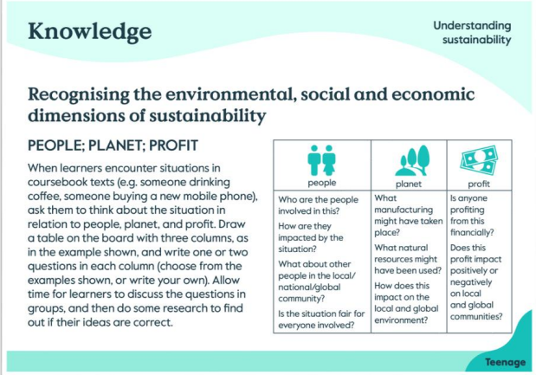
Jeffries explained that this activity supports the “knowledge” component, as it encourages students not only to learn language but also to reflect on the environmental, social, and economic impact of electric scooters. In this way, learners start to see how different sustainability issues (environmental, social, and economic) are connected, they use data and information to make better decisions, identify challenges to sustainability, and appreciate the importance of respecting and including everybody (especially those who are not always heard) in such sustainability discussions.
One good thing is that the framework offers suggestions for adapting these activities to different age groups, such as young learners or young adults; and below, there is another version of this exercise that can be adapted for young adult learners:
Jeffries also shared another practical idea related to the values dimension. They showed pictures of unusual animal friendships from around the world, such as a cat and a fox living together near Van Lake in Turkey. Students were asked, “What would they say if they could speak?” This led to a discussion about empathy and human–animal relationships, which could later be developed into a word formation activity using vocabulary about friendship and relationships. Through this task, students work on language while also developing empathy and awareness of caring for people, animals, and nature. It also promotes respect for human and animal rights, fairness, and equality. I personally liked the inclusion of animal rights in this activity.
Another meaningful point that Jeffries emphasized is that the values dimension includes “demonstrating resilience and adapting to change.” Jeffries reminded us that learners today may feel overwhelmed by global or personal challenges, including environmental problems. In our own teaching contexts, many students face stress considering all economic, political, and personal challenges as well the environmental issues. Therefore, showing empathy and supporting their emotional resilience is an essential part of sustainability in education. Below is a simple idea that shows how this can be used in a lesson:
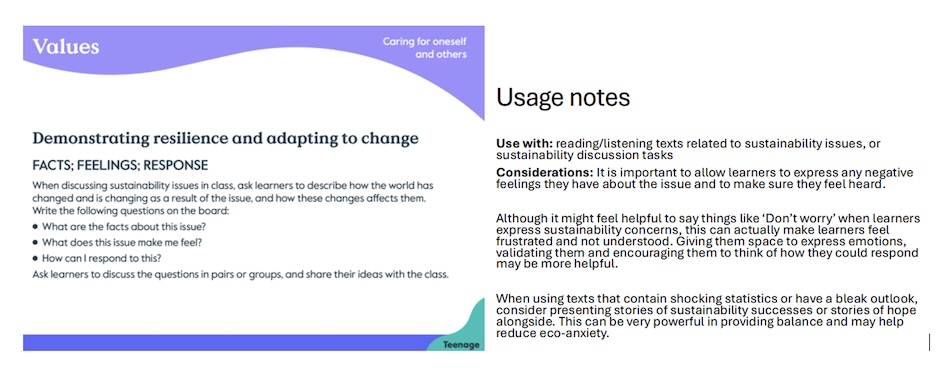
Finally, Jeffries shared some useful suggestions for the educators mentioning that teachers should be aware of the potential for eco-anxiety among learners, normalize their negative emotions, and give them space to express these feelings. They underlined the importance of sharing stories of hope and encouraging students to believe that change is possible. Supporting learners in developing a sense of agency can help them feel that their actions and feelings matter.
In conclusion, I found Jeffries’ session very valuable for refreshing our perspective on sustainability and exploring how it can be meaningfully integrated into ELT classrooms. By revisiting this framework, we can help our learners develop a deeper understanding of sustainability, appreciate our world more, and become more respectful, hopeful and resilient individuals who are also more aware of non-discrimination, committed to quality, respectful of all living things, and responsible for all actions.
NB: All visuals are taken from Cambridge Sustainability Frame website.
https://view.ceros.com/cambridge/sustainability-elt/p/1
https://assets.cambridgeenglish.org/events/sustainability-framework-for-elt.pdf
https://assets.cambridgeenglish.org/cambridge-sustainability-activities.pdf