
FOAI Event
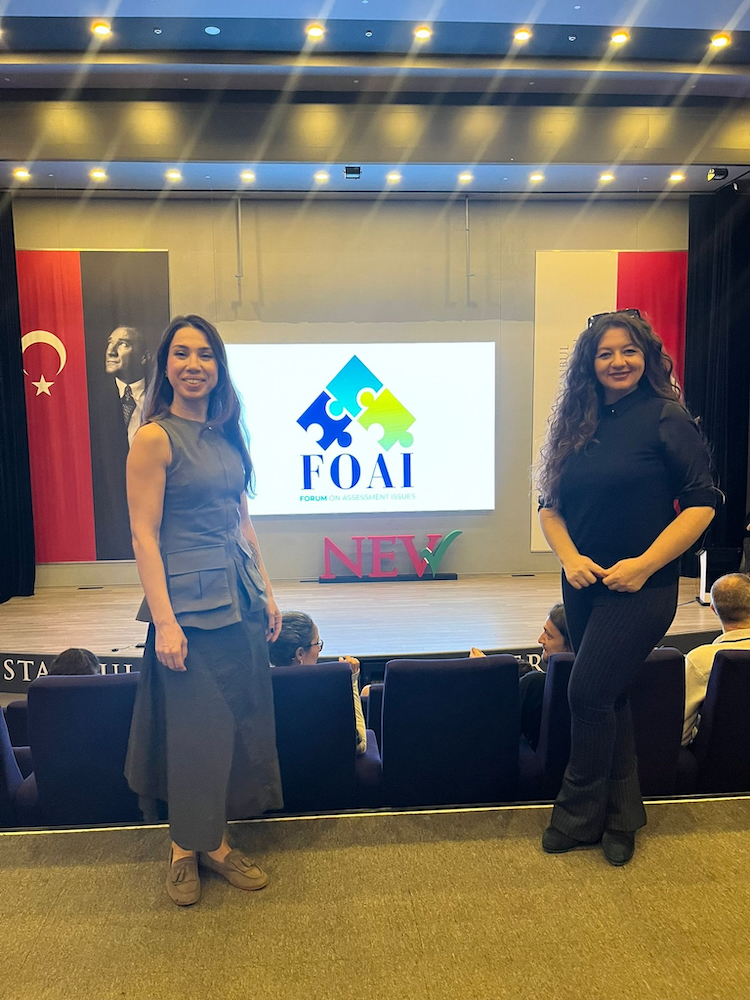
Plenary Report – FOAI Event, Nişantaşı University, November 7-8, 2025
by Gamze Bozkurt & İrem Gedil
On November 7-8, 2025, we attended the FOAI Event hosted by Nişantaşı University, where the plenary talk by Prof. Dr. Claudia Harsch focused on the role of the CEFR (Common European Framework of Reference for Languages) in reshaping curriculum design, assessment practices, and classroom transparency.
The plenary began by reframing the CEFR not as a checklist but as a system designed to inform teaching, learning, and assessment. When used critically, the CEFR can:
• foster multilingualism and provide a common metalanguage
• inform learning, teaching and assessment goals
• guide curriculum development and educational standards
• support constructive alignment between learning outcomes, teaching, and assessment and provide meaningful comparison
• provide a basis for locally relevant tasks, rating scales, and benchmarks
Whereas CEFR does not:
• talk about errors and place learners a level according to the errors they make
• calculate a learner’s language skills mathematically
The emphasis throughout the talk was that the CEFR only becomes meaningful when descriptors are analysed and adapted to a specific institutional context, which signifies the need for localization of interpretation.
One of the most thought-provoking sections addressed a persistent challenge in language education: Are we assessing proficiency, or achievement?
• Proficiency scales (CEFR, IELTS, TOEFL, Pearson, Cambridge) measure global ability.
• Classroom assessment often measures what has been taught rather than real-world ability.
This distinction has practical implications. A student who performs well on a course-based B1 achievement test may not necessarily demonstrate B1 proficiency on an external exam. The plenary provided a simple but effective illustration, some test providers define “being at a level” as solving 50% of the tasks at that level, while some researchers require mastery of 80% of them. The result is inevitable, alignment without shared interpretation leads to discrepancies. The plenary presented a reform model developed at the Language Centre serving four universities in Bremen. The process moved in five interrelated steps:
1. Revisiting learning outcomes with CEFR lenses
2. Developing test specifications for all skills and levels
3. Designing shared tasks and assessment checklists
4. Training teachers using local performance examples
5. Implementing aligned assessment in classrooms
The power of this model lies in collaboration among teachers, coordinators, and researchers working together to co-construct meaning, ensuring the CEFR is not imported but interpreted.
Outcome evaluation data from the reform showed three key gains:
• Higher task authenticity
• Greater transparency and comparability across courses
• Increased need for re-organization (a reminder that change is both structural and pedagogical)
The message was encouraging but honest: CEFR alignment improves assessment, but it also requires time, teacher training, and institutional commitment.
Several practical tools were shared, including:
• a B2.1 writing checklist linking task fulfilment, language range, and register to descriptors
• an EAP module description written entirely in CEFR-aligned learning outcomes
• local rating grids designed for benchmarking internal tasks
• visual frameworks that map descriptors to real classroom performance
These tools demonstrated what many teachers already feel instinctively: alignment becomes workable only when abstract descriptors are turned into visible, shared instruments.
Our Reflections:
What we valued most in this plenary was its balance of theory and practice. Instead of idealizing the CEFR, the presenter highlighted its limitations, questioned the myth of perfect standardization, and reminded us that interpretation is always local. Two key points stood out clearly for us:
1. What does it really mean to “be B1”?
The plenary challenged the common assumption that students must meet 100% of the descriptors to be considered at a CEFR level.
o Some test providers classify a learner as B1 if they can successfully complete 50% of level-appropriate items.
o Other researchers suggest 80% performance is enough to claim level attainment.
This raised an important question: Are we assessing our learners according to a fixed standard, or according to an interpretation of that standard? The difference has huge implications for grading, progression, and fairness.
2. Localization is not optional — it is essential.
The CEFR is not a ready-made template to “apply.” It needs to be localized according to:
o national expectations
o institutional culture
o learner profile
o assessment traditions
o academic goals
Without this contextualization, CEFR alignment becomes imitation rather than transformation. The plenary reminded us that a “global” framework only becomes meaningful when it is translated into local practice — through shared criteria, shared classroom examples, and shared professional dialogue.
These two points made us reflect on our own institution: How do we define “being at a level”? And to what extent have we truly adapted the CEFR to our context, rather than adopted it? Therefore, the real question after this plenary was not “Are we aligned to the CEFR?” but rather “How do our students experience that alignment in the tasks, feedback, and scores they receive?” The answer, as the talk suggested, will always depend on collaboration, not conformity.
Gamze Bozkurt & İrem Gedil
English Language Instructors, Sabancı University