2026 TOEFL iBT: Key Changes and Considerations

2026 TOEFL iBT: Key Changes and Considerations
by Esra Gün Alayafı, İdil Ertuğan and Neslihan Demirdirek
On November 21, 2025, we attended the ETS event “Unlocking the Power of TOEFL,” where representatives presented and discussed the updates planned for the TOEFL iBT, scheduled to take effect in January 2026. According to ETS representatives, the TOEFL iBT enhancements introduce a more student-friendly experience without compromising quality or academic standards. They explained that while the topics will be more relevant and practical, the academic depth will remain intact and be supplemented with modernized updates and content.
The most notable updates are summarized below:
• Multistage Adaptive Testing in the Listening and Reading Sections: ETS will implement a multistage adaptive design for the Reading and Listening sections of the TOEFL iBT. This means the test will adjust in real time based on a student’s performance.
• Section Order: The current TOEFL iBT section order is Reading → Listening → Speaking → Writing, while the updated order will be Reading → Listening → Writing → Speaking.
• Score Reporting: TOEFL iBT score reports will feature a new 1–6 scale, in half-point increments, aligned with the Common European Framework of Reference for Languages (CEFR). A comparison table can be found at ETS TOEFL Score Understanding.
• AI and Human Scoring: Responses in the Speaking and Writing sections are evaluated by both human raters and an AI scoring engine. Although the exact proportion of responses reviewed by humans versus AI is not publicly disclosed, they have told us that not every response will necessarily receive human review. This suggests increased reliance on AI scoring for routine evaluation, with human raters stepping in when needed.
• Two new and unexpected task types: During the event, ETS representatives pointed out that two new task types have already generated questions and unexpected reactions from teachers. This proved to be true, as many attendees raised questions and concerns during the event. The two new tasks are:
1) Word Completion Task: Test takers read a short paragraph that contains ten incomplete words. Only the first two or three letters are provided, and students must complete the words by adding the missing letters.
2) Listening & Repeating sentences: Test takers listen and repeat sentences of different lengths from 6 syllables to 19 syllables. The sentences are placed in meaningful contexts, for example, a campus tour guide giving information. This section is brief, taking only about 3.5 minutes, but according to the information provided at the event, it has a high reliability score since it gives strong and consistent results in assessing speaking and listening ability of low-level and high-level test takers.
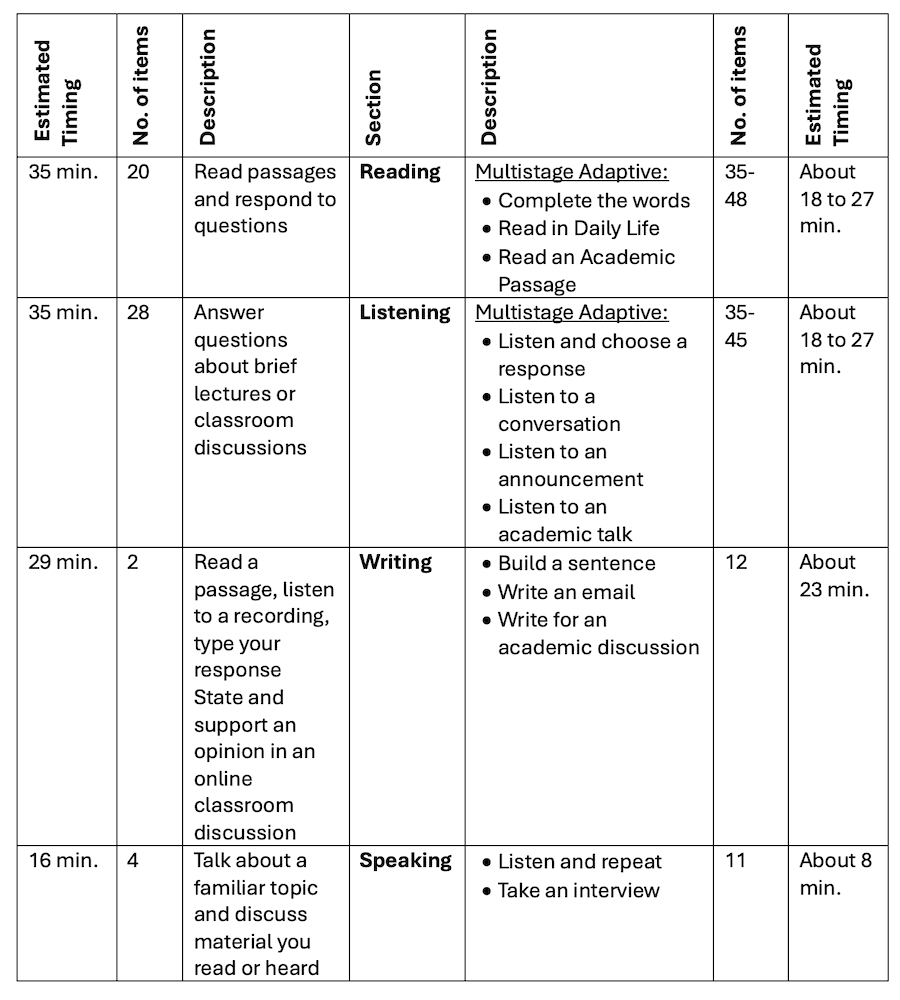
• Shorter Test Duration: The revised format shortens sections (fewer Reading passages and Listening items), removes unscored questions, and streamlines tasks, resulting in a shorter test with overall test time estimated between 67 and 85 minutes.
In terms of test specifications, there have been alterations in each component. Below is a table comparing the previous version with the new one:
While these updates aim to modernize the test and improve efficiency, several points should be noted. The increased reliance on AI for scoring raises questions about transparency and fairness, particularly since not every response will receive human review. The reduction in test length could also affect the comprehensiveness of assessment, potentially limiting the test’s ability to reliably measure language proficiency across all skill areas. Additionally, while the test content is designed to be more relevant and practical, it remains unclear whether the new format will meaningfully improve the test-taking experience or provide stronger indications of academic success.
Overall, while the 2026 TOEFL iBT updates introduce innovations that may offer practical benefits, these changes should be approached cautiously. Further evaluation on the impact of these changes on assessment quality, scoring accuracy, and fairness will be necessary once the revised format is implemented and widely used.