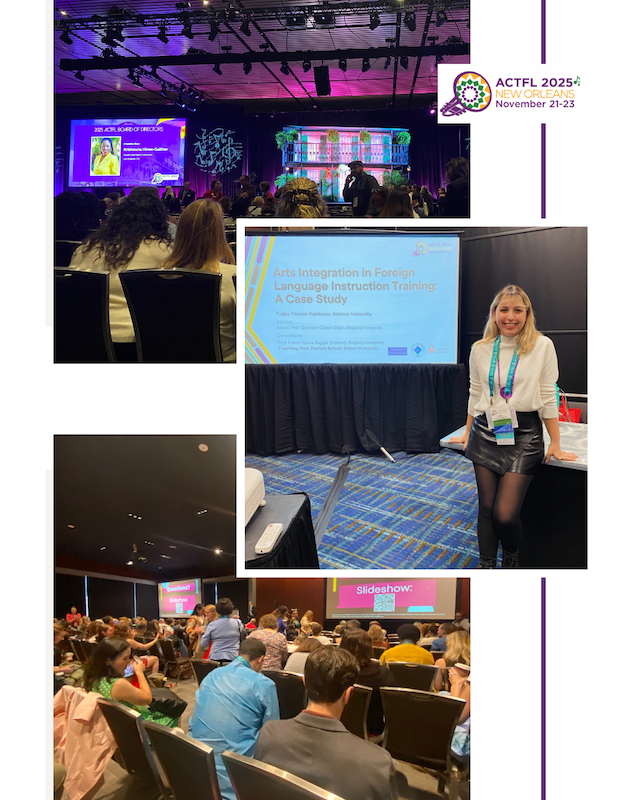
Reflections from the 2025 ACTFL Conference
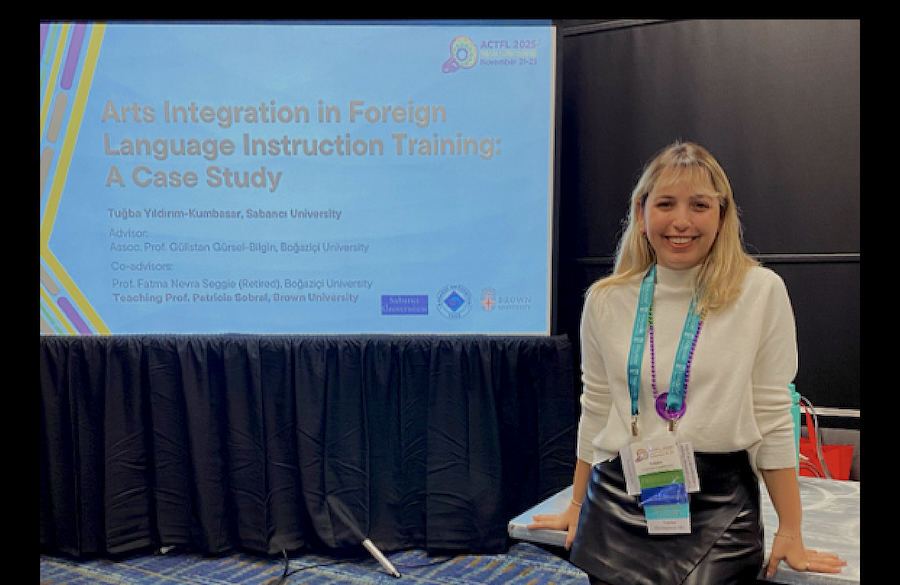
Reflections from the 2025 ACTFL Conference
By Tuğba Yıldırım Kumbasar
I had the opportunity to attend the 2025 ACTFL Annual Convention and World Languages Expo on November 21-23 for the first time, both to co-present my PhD research “Arts Integration in Foreign Language Instruction Training: A Case Study” with Prof. Patricia Sobral from Brown University, and to explore the latest trends in language education. I was particularly drawn to the conference’s inclusive approach, covering a wide range of languages, which made it an ideal setting for cross-linguistic exchange, a type of engagement that has always energized my thinking. The event fostered an environment where curiosity, creativity, and meaningful professional connections were central, offering a clear model of effective large-scale conference design and providing insights that will continue to shape my work and perspective.
The organization of the conference impressed me from the very beginning. Sessions were clearly categorized by language, proficiency level, and teaching context, making it easy to navigate the schedule. Beyond this clarity, the program actively encouraged engagement through research and practice-oriented presentations with thoughtful Q&A segments, roundtables, collaborative workshops, informal networking spaces, and the interactive World Languages Expo. Witnessing such a carefully planned structure prompted me to reflect on my own design practices and sparked ideas for future projects. These reflections continue to influence my work, motivating me to create learning spaces that guide, inspire, and connect learners in meaningful ways.
The sessions offered a wide range of perspectives, but the moment that left the deepest impression was Miguel Cervantes’ opening keynote. From the very beginning, it set the tone for a conference that would challenge and inspire me beyond the professional sphere. Hearing him recount his journey from regional theater to portraying Alexander Hamilton on Broadway, alongside the profound personal loss he and his family experienced, was both moving and deeply inspiring. His story illustrated the power of perseverance and dedication, while also showing how personal experiences can be transformed into meaningful support for others. It encouraged me to reflect on how the values guiding my own life can shape and enrich my professional practice.
Each session I attended offered a unique perspective, shaped by the presenters’ diverse backgrounds. One that I found especially relevant to our teaching context was Kwangmi Kim’s talk on reflective teaching, which left a strong impression on me. Her session prompted me to look at my own teaching with greater intentionality. Drawing on John Dewey’s reminder that “we do not learn from experience; we learn from reflecting on experience”, she demonstrated how everyday classroom moments can become catalysts for growth when we take time to examine them. What resonated particularly with me was her adaptation of Farrell’s (2020) framework to create her own reflective model, in which evidence-based reflective practice is grounded in five key questions teachers ask themselves about their work: What do I do? How do I do it? Why do I do it? What is the result? And will I change anything based on the answers to these questions? Hearing her describe this process made me consider how reflection is shaped not only by theory but also by institutional realities, personal needs, AI-generated suggestions, and the professional principles we aim to uphold such as student engagement and autonomy, coherent curriculum design, collaborative classroom climate, sustained professional development, communication with stakeholders, and bridging the gap between theory and practice. She also discussed how keeping a data-driven record of her reflections influenced her development over time. Her shift from reacting to events to engaging in purposeful, strategic reflection made me reconsider how I respond to challenges in my own teaching. She explained that Farrell’s structure became both a mirror for understanding her current practice and a map for guiding her forward, transforming moments of burnout into opportunities for breakthrough. Her experience highlighted reflection as a crucial mechanism for sustaining long-term professional growth, encouraging me to rethink my own reflective habits and explore more systematic ways to integrate them into my practice.
In addition to the sessions, the conference’s exhibition area offered insight into the range of tools and resources shaping language education today. Booths from curriculum publishers, language-learning labs, educational software developers, and professional development organizations provided an overview of emerging approaches and technologies. I was particularly interested in the materials offered by Teach Yourself US, whose extensive catalog of language-learning books made me think about how their resources could support my own language-learning goals as well as those of learners interested in studying languages other than English. Another tool that caught my attention was Speakology AI. Although I have only had the chance to explore it briefly, its design seems well aligned with the kind of support I hope to provide my students. The platform offers guided conversational practice connected to curricular objectives, assignable homework tasks that are automatically evaluated with feedback, and autograding features for pronunciation, grammar, and vocabulary through oral exam-style interactions. While I still need to examine the tool more closely, my initial impression is that it has potential to complement classroom instruction and enrich students’ independent learning experiences.
I am grateful to have had the opportunity to participate in this conference. Like many other events I attended, ACTFL 2025 reminded me that professional development is not a checklist to complete, but a continuous process fueled by curiosity, reflection, and human connection. The experience also highlighted how engaging with ideas, people, and experiences can strengthen this ongoing journey. Building on these insights, I look forward to applying them in my practice and continuing to learn and reflect in ways that meaningfully support my students and colleagues.
Reference
Farrell, T. S. C. (2020). Reflective Teaching, Revised Edition (2nd ed.). TESOL International Association.