
Webinar: Empowering Self Study with Generative AI
 Webinar: Empowering Self Study with Generative AI
A Review by Seda Ertüm Emirler
On 11th December, I attended a webinar delivered by Jasmin Silver from Cambridge Publications. The session began by highlighting a common issue many teachers face today: although students are increasingly turning to generative AI tools, they do not always use them in ways that genuinely support learning.
The webinar was designed to help teachers guide students to use AI more thoughtfully and effectively, particularly to support independent thinking and study skills. During the webinar, participants explored common mistakes students make when using AI, such as relying on AI for quick answers or copying responses without reflection. Jasmin Silver also shared simple and practical classroom strategies that teachers can use to address these issues.
A key message of the webinar was the importance of encouraging students to see AI as a learning partner rather than a shortcut. When used responsibly, AI can help students ask better questions, reflect on their ideas, and develop confidence in their own thinking. Overall, the webinar emphasized that thoughtful AI use can support learner autonomy and help students take greater ownership of their learning.
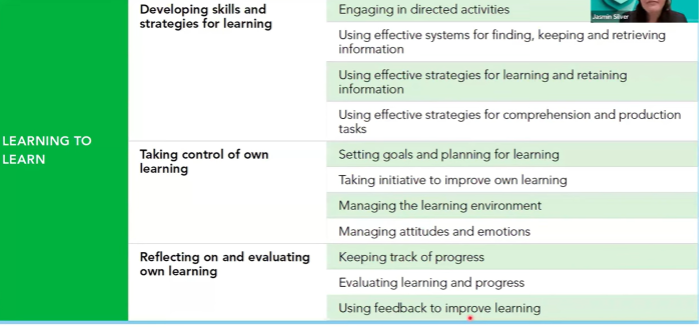
The framework presented in the webinar, illustrated in the screenshot above, was particularly useful in clarifying how AI use can be aligned with learning-to-learn skills. The slide emphasizes three interconnected areas: developing skills and strategies for learning, taking control of one’s own learning, and reflecting on and evaluating learning. These areas closely mirror the challenges many students face when using AI tools independently.
As Jasmin Silver highlighted, AI can support students in engaging in directed activities, organising and retrieving information, and applying strategies for comprehension and production—but only when students are taught how to use it purposefully. Without this guidance, learners may bypass goal-setting, planning, and reflection, which are essential components of effective learning.
The focus on learner autonomy was especially relevant. The slide reinforces the importance of students setting goals, managing their learning environment, monitoring their progress, and using feedback to improve. These are areas where AI can either weaken or strengthen learning habits. When used thoughtfully, AI can prompt students to reflect on their progress, evaluate their work, and revise their output rather than simply accepting an answer at face value.
This framework encouraged me to think more critically about how I introduce AI in my own classroom. Rather than treating AI as an external tool, I aim to embed it within learning strategies that promote planning, reflection, and ownership. The webinar clearly demonstrated that responsible AI use is not about restriction, but about helping students become more aware, independent, and strategic learners.
This framework was also mentioned in the webinar:
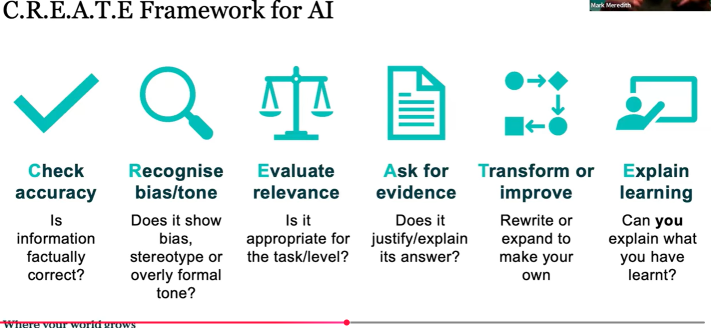
The C.R.E.A.T.E. framework closely reflects the principles discussed during the webinar, particularly the idea of guiding students to engage critically and reflectively with AI rather than using it as a shortcut. Each stage of the framework encourages learners to question, evaluate, and transform AI-generated output, supporting deeper learning and greater learner autonomy. By encouraging learners to check accuracy, recognize bias, evaluate relevance, and transform AI-generated responses into their own work, the framework promotes independent thinking, metacognitive awareness, and deeper learning. It also supports the view of AI as a learning partner, not a shortcut, which was a key message of the webinar.
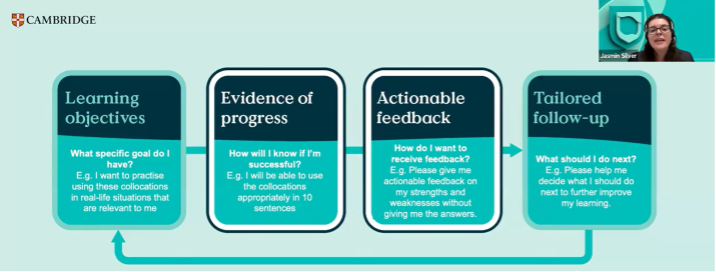
Another point that was highlighted is the importance of setting clear learning objectives and making the learning process transparent when using AI. As discussed in the webinar, encouraging students to define specific goals, identify evidence of progress, and request actionable feedback helps shift AI use from answer-generation to skill development. The inclusion of tailored follow-up further supports learner autonomy by guiding students to reflect on feedback and decide on meaningful next steps in their learning.
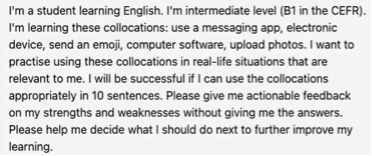
This student prompt demonstrates effective goal-setting and guided AI use, as it clearly defines the learner’s level, target language, and criteria for success. By requesting actionable feedback rather than direct answers, the task encourages reflection, self-assessment, and active learning. This approach reflects the webinar’s emphasis on using AI to support learner autonomy and skill development, while ensuring that responsibility for learning remains with the student.
Overall, the webinar highlighted the importance of guiding students to use AI thoughtfully and purposefully rather than as a shortcut. Through practical strategies and frameworks such as C.R.E.A.T.E. and goal-oriented prompting, teachers can help learners check accuracy, reflect on feedback, and take ownership of their learning. Used in this way, AI becomes a supportive learning partner that promotes critical thinking, learner autonomy, and meaningful progress.