
Human Touch in the Age of AI: Notes from METU ELT Convention
Human Touch in the Age of AI: Notes from METU ELT Convention
Burçin Şenyurt
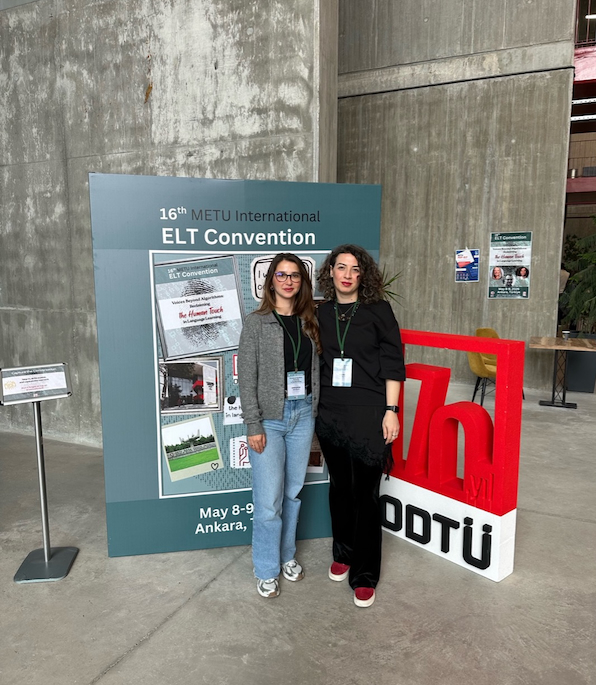
On the 8th and 9th of May, my colleague Buse Aral and I attended the 16th METU ELT Convention held at the METU campus in Ankara. The event brought together educators, researchers, and teacher trainers from different institutions, creating a space for sharing classroom experiences, practical ideas, and current research related to language teaching in today’s increasingly digital world.
This year’s theme, “Voices Beyond Algorithms: Reclaiming the Human Touch in Language Learning,” focused on the growing role of technology and AI in education while also reminding us of the importance of maintaining the human side of teaching and learning. Throughout the convention, many of the sessions highlighted the idea that although digital tools can offer valuable support in language education, meaningful learning still depends greatly on empathy, communication, creativity, and genuine interaction in the classroom.
One of the plenary talks that particularly stood out to me was “Philosophical Concerns in Higher Education” by Dr. Tufan Kıymaz. He began the session by emphasizing the importance of active learning and argued that genuine learning takes place when students actively engage in the process rather than passively receive information. Throughout the talk, he highlighted the value of discussion, reflection, and personal involvement in creating meaningful and lasting learning experiences.
Another key point of the session was the importance of critical thinking, especially in an age where AI-generated content is becoming increasingly common. Dr. Kıymaz stressed that students need to question information carefully, distinguish between “knowing” and “being certain,” and develop intellectual flexibility. He also discussed the importance of AI literacy and how learners should become more aware of the ways technology can influence their thinking, decision-making, and learning habits.
One of the most thought-provoking parts of the talk was his discussion of what AI cannot provide for human beings. He argued that AI cannot truly answer “life questions,” since such questions are shaped by real experiences, emotions, and personal struggles. Similarly, he emphasized that individual identity cannot be generated artificially, as it develops through culture, family background, education, social relationships, and lived experiences. According to Dr. Kıymaz, these human elements are essential parts of the learning process and should not be overlooked in increasingly technology-driven educational environments.
The session also explored some of the potential risks of excessive reliance on AI in education. Concepts such as cognitive offloading, cognitive debt, demotivation, pseudolearning, and alienation were discussed as possible consequences of depending too heavily on AI tools. Dr. Kıymaz explained that when students allow AI systems to do too much of the thinking, analysis, or production for them, learning may become superficial and temporary rather than transformative. He also warned that overreliance on AI could gradually weaken genuine human interaction, reduce meaningful engagement with learning, and even contribute to feelings of isolation and disconnection from others.
;
Another interesting session was presented by Enis Oğuz on the use of AI in Automated Essay Scoring (AES) systems and how recent developments in Generative AI are reshaping assessment practices in language education. The presentation explained that AES systems have been used for many years to evaluate student essays, mainly because they help save time and reduce workload in educational settings. However, traditional AI-based scoring systems usually rely on complex linguistic analysis tools and require considerable technical and statistical expertise to develop.
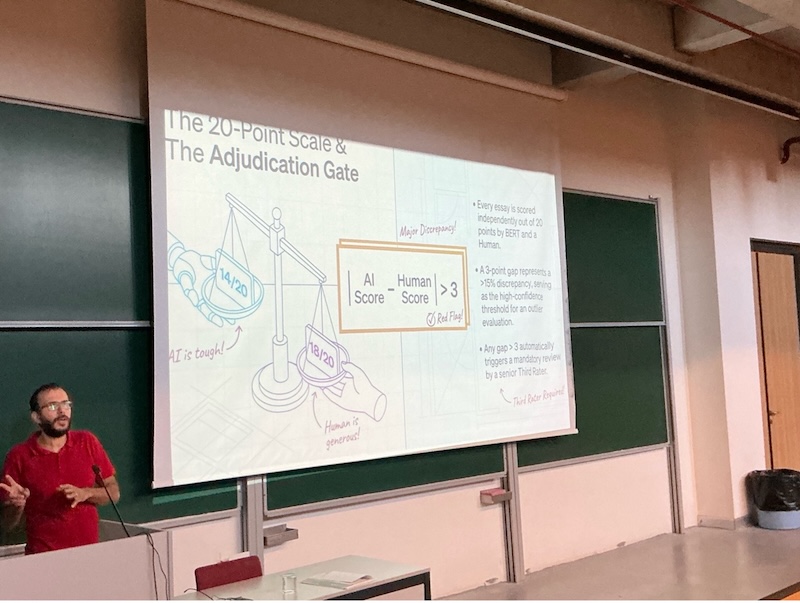
The session also explored whether newer Generative AI tools such as ChatGPT and Gemini could serve as faster and more practical alternatives for essay scoring. Although these models have shown a high level of consistency when evaluating the same essays repeatedly, Oğuz emphasized that their agreement with human raters is still below the desired level, especially when essays contain figurative, implicit, or nuanced language.
One of the main concerns highlighted during the presentation was the tendency of Generative AI systems to “hallucinate,” meaning that they may produce inaccurate or unreliable evaluations by identifying non-existent errors, generating false references, or relying on unsupported scoring criteria. Oğuz also discussed the issue of “generosity bias,” referring to the tendency of Generative AI tools to assign higher scores than human raters and artificially inflate grades. In addition, inconsistency was presented as another major limitation, since the same essay can sometimes receive different scores from the same AI system at different times.
Beyond these reliability issues, the session also addressed practical and ethical concerns surrounding the use of Generative AI in assessment. Oğuz pointed out that such systems can be costly to implement and maintain, while uploading student essays to external AI platforms may raise serious concerns regarding data privacy and confidentiality. For this reason, the use of Generative AI in high-stakes exam scoring remains highly debatable.
As a possible solution, the presenter introduced an alternative approach based on (LLM) Large Language Models such as BERT, which can be trained directly on student essays together with scores previously assigned by human raters. Building on this idea, a hybrid scoring model combining a fine-tuned DeBERTa model with human evaluation was developed. According to the preliminary findings shared during the session, this hybrid system appeared to provide a more reliable and efficient method for assessing L2 English writing.