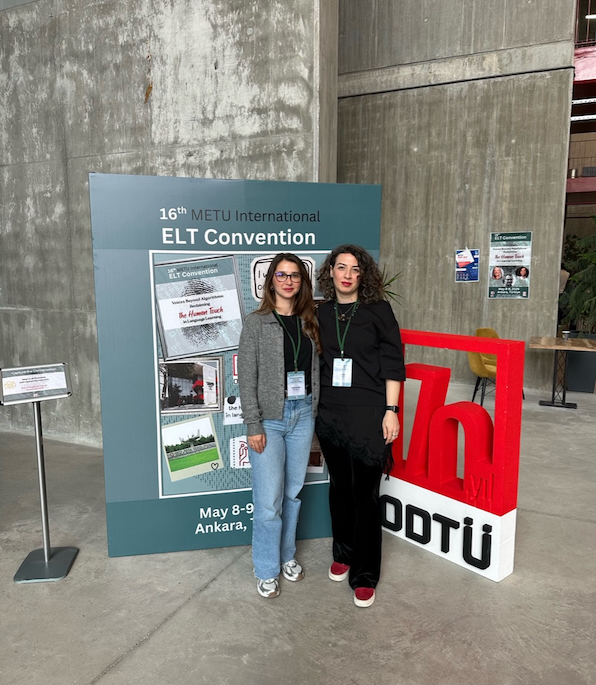
Voices Beyond Algorithms: Reclaiming the Human Touch in Language Learning
Voices Beyond Algorithms: Reclaiming the Human Touch in Language Learning
by Buse Aral
The theme of the 2026 METU ELT Conference was: “It is through human connection that meaning, understanding, and belonging are created.”
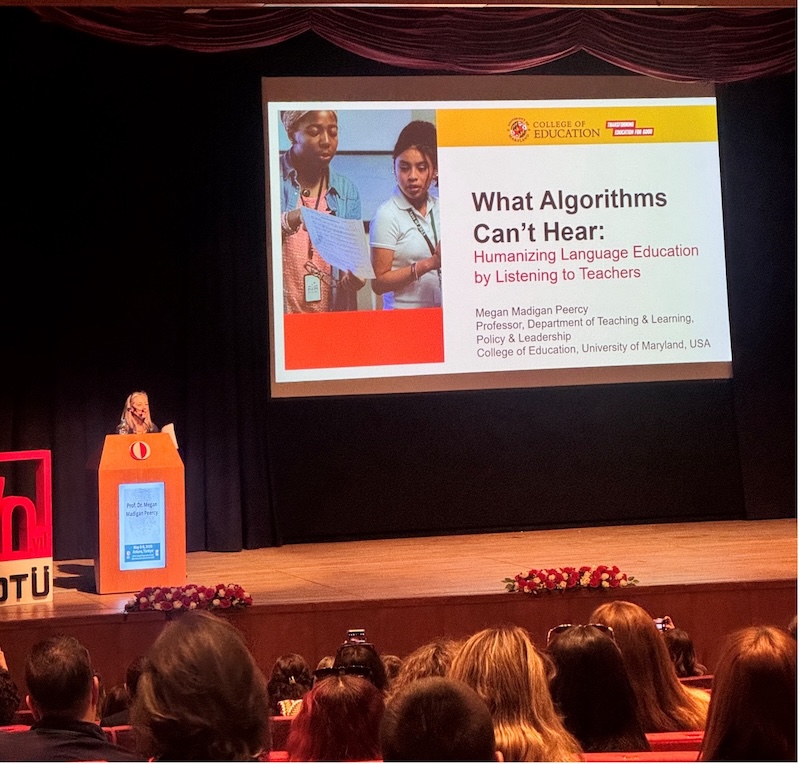
Megan Madigan Peercy began her speech, “What Algorithms Can’t Hear: Humanizing Language Education by Listening to Teachers,” with a short introduction about herself and her family. She then asked an important question: “What makes great teachers?” She encouraged all of us to reflect on our own childhoods, the teachers we remember, and the reasons why those teachers stayed in our minds. It was a powerful reminder to think again about the kind of teachers we would like to become. I immediately thought of my primary school Physical Education teacher and remembered how sweet yet strict she was, and how much I respected both her and her rules.
Mrs. Peercy continued her speech with another thought-provoking question: “What is research?” When we hear this question, we often think of numbers, statistics, or lists of data. But what about sitting together with colleagues and talking about what works well in the classroom and what does not? She highlighted how valuable such discussions can be, especially for novice teachers, and explained that this kind of dialogue is an important step toward becoming a great teacher. According to her, learning to teach requires teachers to be dialogic and humanizing.
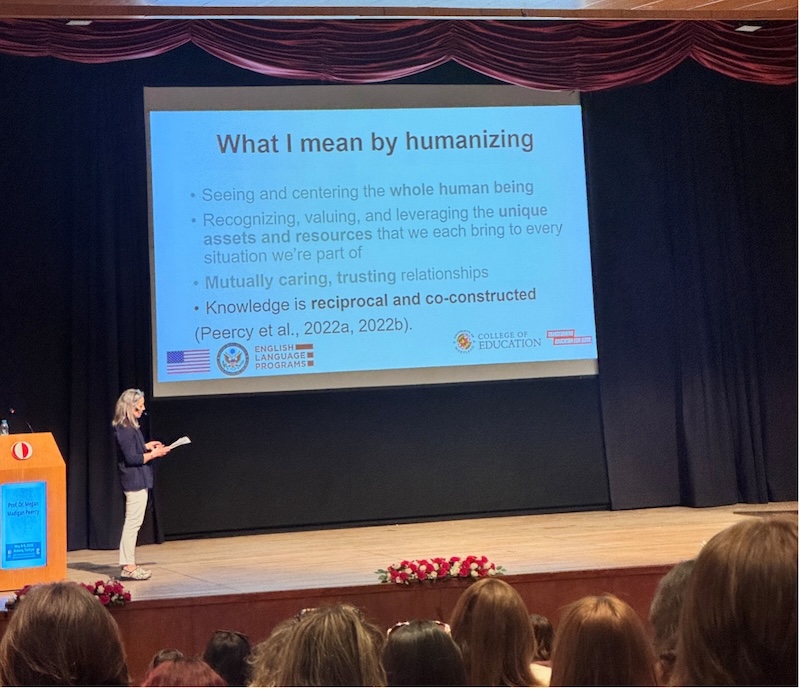
By humanizing, she meant seeing and valuing the whole person. She emphasized that when teachers truly listen, they develop better teaching practices, become more collaborative and innovative, and experience less burnout.
She also mentioned the importance of scaffolding and explained that it will always hold a special place in education. While algorithms and data cannot make students feel seen or understood, teachers — through caring relationships and human connection — can.
Deniz Şallı Çopur, the second plenary speaker, delivered a speech titled “The Indispensable Role of the ‘Disagreeable’ Human Touch.” She began with two powerful metaphors. The first was Michelangelo’s famous painting The Creation of Adam, and the second consisted of magazine covers depicting robotic hands holding skulls. Both metaphors reflected the growing relationship between artificial intelligence and humanity and questioned how this relationship may continue to evolve in the future.
She then shifted the focus of her speech to the abilities of AI in comparison to humans. Some of the most striking points were AI’s ability to remain endlessly enthusiastic about questions, avoid burnout, and never experience writers’ block. In contrast, humans possess qualities such as emotional complexity, ethical judgment, and disagreeableness. Rather than presenting these as weaknesses, Çopur emphasized that these uniquely human characteristics are actually essential in both education and professional life.
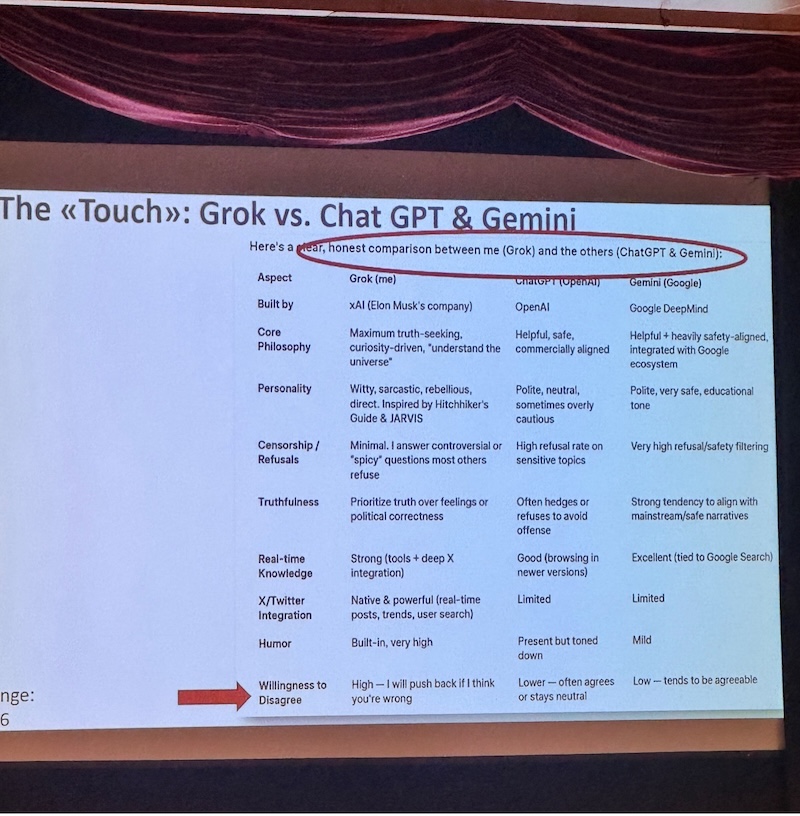
One particularly intriguing part of the session was the comparison between different AI systems and their willingness to disagree. ChatGPT, Gemini, and Grok were each asked about their tendency to disagree with users. Gemini described itself as generally agreeable, with a low willingness to disagree, while ChatGPT was described as even less willing, often choosing either agreement or neutrality. Surprisingly, Grok expressed a much higher willingness to disagree. This comparison led to a broader discussion about the importance of disagreement in human interaction and critical thinking.
Çopur also introduced a diagram comparing “agreeables” and “disagreeables” alongside “givers” and “takers.” The diagram illustrated how workplaces are made up of different personality types, each contributing in different ways. According to the presentation, givers are people who prefer to contribute more than they take, help others without expecting anything in return, and prioritize collaboration and collective success. In contrast, takers tend to focus more on personal gain and recognition.
She further divided these personalities into four categories: disagreeable givers, agreeable givers, disagreeable takers, and agreeable takers. One of the most memorable ideas from the presentation was that “disagreeable givers” are often the people who provide the critical feedback that others may not want to hear but genuinely need to hear. On the other hand, agreeable people were described as supportive and helpful, though sometimes overly accommodating.
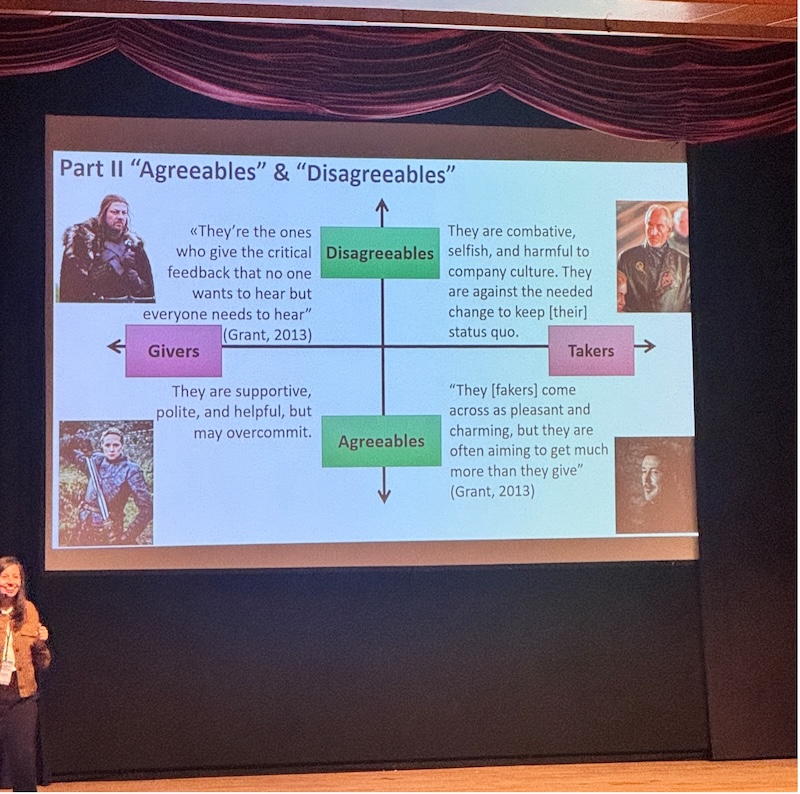
Çopur also emphasized that disagreement should not always be viewed negatively. She argued that disagreement and friction are necessary for growth, quality, and learning. On one of her slides she stated that “a society without disagreement is not a stable or free society.” She also highlighted that healthy debate strengthens relationships and creates opportunities for reflection and improvement. She concluded second part of her speech by reminding the audience that disagreement, when approached respectfully, is not destructive but rather an essential part of human connection and progress.
Toward the end of her speech, Çopur moved on to the third part of her presentation, where she raised an important question: “Can AI replace the human touch of disagreeable givers?” To support this discussion, she referred to a study titled “The Educational Affordances and Challenges of Generative AI in Global Englishes-Oriented Materials Development and Implementation” (Lo, 2025).
The study highlighted the relationship between AI and the human element in materials development. According to the findings, teachers acknowledged that AI can provide sophisticated support and serve as a valuable educational tool. However, she also emphasized that AI cannot replace the human aspects that are essential to language education, particularly in Global English Language Teaching. The presentation stressed that while AI may assist teachers, it still lacks the cultural awareness, empathy, personal insight, and authentic human connection that educators bring into the classroom. Teachers were described as irreplaceable in helping students develop a genuine appreciation for linguistic and cultural diversity.
Çopur concluded her talk with several key takeaways regarding the indispensable role of the “disagreeable” human touch in education. First, she argued that AI should be accepted as a tool and adapted thoughtfully into educational contexts rather than feared or completely rejected. Second, she emphasized that ideas, innovations, and changes should always be supported by research. Third, she encouraged educators to recognize and value disagreement, especially when it comes from “givers” who aim to improve systems and practices rather than simply criticize them. Finally, she ended with a strong reminder to keep the human touch at the center of education.