The University in an Age of Alternatives: Notes from an Instructor
The University in an Age of Alternatives: Notes from an Instructor
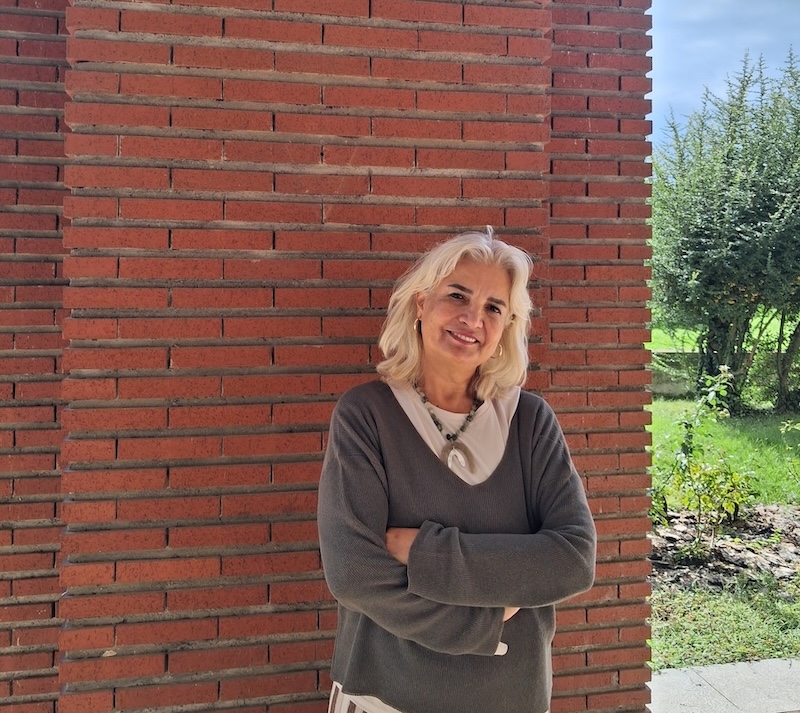
By Nezaket Özgirin, Sabancı University School of Languages
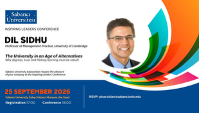
On 25 September 2026, I spent the evening at the Sakıp Sabancı Museum for the Inspiring Leaders Conference. The speaker was Professor Dil Sidhu of the University of Cambridge (IfM Engage), and his title was one that any of us working in a university would find hard to ignore: The University in an Age of Alternatives: Why degrees, trust and lifelong learning must be rebuilt. I went as an instructor, curious to hear what he thought our future looked like, and I came away with a notebook full of ideas that I would like to share with colleagues.
 He opened with a warm "İyi akşamlar, hoş geldiniz" and then built his case in four "movements".
1. The old bargain is breaking
His starting point was reassuring. Demand is not the problem. According to the latest UNESCO figures, published in March 2026, there were 269 million higher-education students worldwide in 2024, up from 103 million in 2000. That is about 43% of the relevant age group, and 7.3 million of those students study outside their home country. (Additional information: In Türkiye, YÖK counts about 6.3 million students in 208 institutions for the 2025-26 academic year.)
So people still want what universities offer. What is weakening is trust. He showed a wall of UK headlines about student debt, "devalued" degrees and graduates who feel "ripped off". His point was that the university used to sell a whole bundle: knowledge, status, employability, networks, identity and the promise of a better life. Today AI tutors, online platforms, employer academies and certificates each compete for one piece of that bundle. As he put it, "The university used to sell the whole package. The market is now pricing the parts."
He was not pessimistic, though. We have heard "universities are dead" before, with MOOCs, with coding bootcamps and during the pandemic, and enrolment kept rising each time. Bologna, Oxford and Harvard have all survived earlier disruptions by adapting. His takeaway was simple: change doesn't kill universities, but refusing to change does.
2. What learners now need
A degree, he argued, can no longer just say "trust me". Families are asking what value looks like, and the answer has to be visible without being reduced to salary. That means portfolios, research experience, authentic assessment and evidence of what a learner can now understand, do, question, build and contribute.
One metaphor has stayed with me: degrees are operating systems, and certificates are apps. The degree provides judgement, identity and an intellectual architecture, and shorter courses in areas like AI fluency, data or leadership are added on top throughout a working life of 40 or 50 years. Graduation should therefore change the relationship with the university, not end it.
He was careful about microcredentials. They need "routes, rigour and recognition, not a shelf of badges", and shorter learning should be a ladder that leads to the next step. "If everything becomes a credential, nothing feels like an education."
He also reminded us why this matters now: 39% of workers' core skills are expected to change by 2030, and 63% of employers say skills gaps are a major barrier. His line got a laugh in the hall: "Committees are excellent at agendas. Markets tend to prefer calendars." Yet he did not want universities to become training centres. Fast-changing skills such as data and cybersecurity have to sit alongside durable ones such as critical thinking, creativity and resilience.
3. What AI changes
This was the part that spoke most directly to us in the hall. According to his slides, 92% of UK undergraduates now use AI tools in some form, and 88% use generative AI for assessments. When content becomes cheap, judgement becomes expensive. The scarce skills are asking good questions, checking evidence, understanding context and taking responsibility. His advice for teachers was memorable: "If the machine gives an answer in five seconds, teach students which answers deserve to be believed."
On assessment, he argued that the one-shot essay is less credible on its own, because it invites the question "Did the student produce this?" More credible designs include process evidence, live problem-solving, reflective explanation, oral defence and authentic projects. In his words, we may need fewer assignments that prove a student can produce text, and more that prove a student can think.
As someone who teaches English, I found this familiar and encouraging. Process writing, drafts with feedback, speaking tasks and reflection already give us the kind of evidence that a chatbot cannot easily fake. Our challenge is to make that evidence count for more.
He linked this to a wider idea: "Truth is a method, not a slogan." In an age of misinformation and AI abundance, a university earns its authority through evidence, peer review, transparency and the willingness to correct itself.
4. What universities must become
In the last movement, he described the university that will thrive: legible, trusted, connected, adaptive, human and financially resilient. It does not need to be the oldest, the richest or the highest ranked, but it does need to be understandable and open to scrutiny. "The future will be hard on vague universities."
The participants in the hall asked many clarification questions, and Sidhu answered them all with examples from various universities in the world.
A few of his points are worth passing on:
● Research, teaching, and knowledge transfer work as one flywheel. Each mission should make the other two better, and the "third mission" of working with industry and society "should not live on the third floor".
● Student experience is strategy, not a service layer. Only 43% of new bachelor's students finish within the expected time, and the figure reaches 70% only after three more years. "A university that wants lifelong relationships has to earn the first relationship well." For a preparatory programme like ours, that first relationship is often us.
● Financial resilience is academic resilience. A university with several sources of income, such as research funding, philanthropy, executive education and alumni, can better protect its mission. When resources are tight, he suggested asking what we can stop, combine, reuse, or amplify with what we already have.
● He closed with a view from Istanbul. He traced a Turkish tradition of linking knowledge to capability, from the Ahilik guilds of the 13th century to the Mühendishane in 1773 and the university reform of 1933. He ended with the opening of Sabancı University in 1999, whose departmentless, interdisciplinary design he called "a concise case in point".
Questions worth taking forward
Professor Sidhu left us with two questions that every university could usefully ask itself in the era of AI:
● If our university disappeared tomorrow, what would students, employers and society genuinely struggle to replace?
● What should a graduate be able to do that an AI tutor, a certificate platform and a smart employer cannot reliably produce alone?
● I would add a third for all schools. What can learners show, in their own voice and through their own process, that AI cannot do for them?
I am relieved to say that in the School of Languages (SL) we ask this question constantly, and we keep adjusting our system and our assessment to the age of AI. However, there is a lot to do for many education systems. Taking Professor Sidhu's presentation as a guide, the work ahead looks something like this. The ideas in parentheses include some ideas adopted here in SL
● Assess the process as well as the product. Drafts, notes, feedback and revisions show how a student arrived at a text. A single finished essay no longer proves who wrote it. (process writing)
● Let students defend their understanding. Short oral follow-ups, live problem-solving and reflective explanations reveal what a learner really knows. In a language school, speaking and in-class writing are natural places for this. (individual tutorials)
● Teach judgement alongside language. Students will use AI anyway. Our job is to teach them to ask good questions, check evidence and decide "which answers deserve to be believed". (training learners Critical Thinking Skills, CTS)
● Make learning visible. Portfolios and authentic tasks let students show what they can understand, do, question, build and contribute. This is more convincing than a grade alone. (learner portfolios)
● Be clear and open about AI. Students need to know when AI use is welcome, when it is not, and why. A university that is "legible" explains its rules and its reasons. (AI training)
● Earn the first relationship well. For many students, the preparatory year is their first experience of university. Belonging, support and a sense of progress in that year shape everything that follows. (clubs, social gatherings, support tutorials, individual and academic advisors….etc.)
● Keep learning ourselves. Teachers need time, training and room to experiment with new tools and new assessment designs, and we need to share what works. (creating time and resources for professional development opportunities)
None of this can be done in a single semester, and no school has the whole answer. That is why I find his final slide so fitting: "The conversation begins where the speech ends." I hope this post helps to foster conversation among all parties.