
Intelligent AI? Notes on Source-Grounded AI and the CEFR from Eaquals Online 2026

Intelligent AI? Notes on Source-Grounded AI and the CEFR from Eaquals Online 2026 Oct 10, 2026
by Soner Yaşar
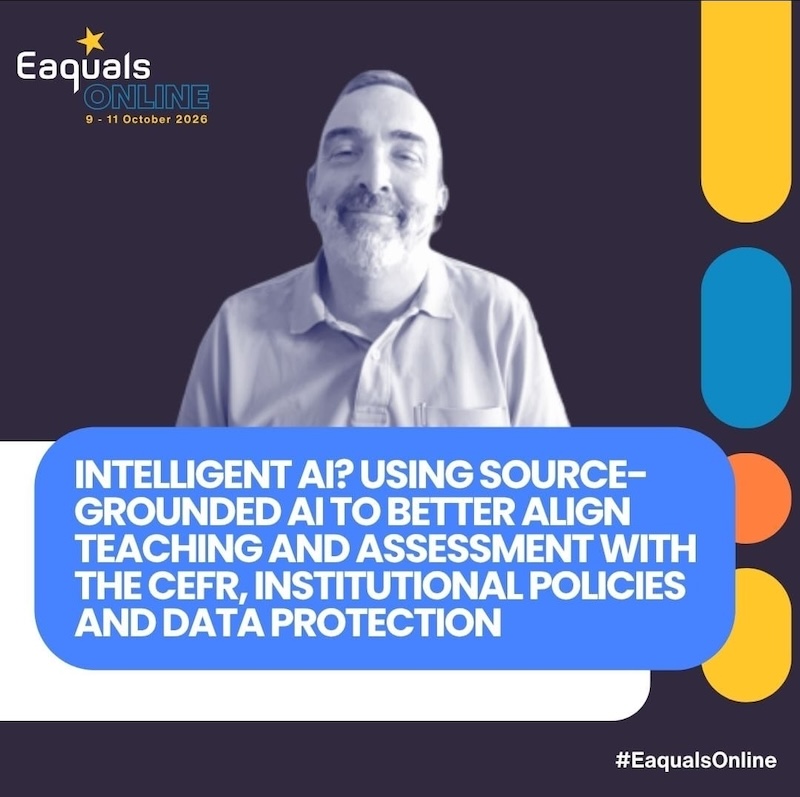
On 10 October 2026, I attended Eaquals Online 2026, a weekend of concurrent online sessions for language education professionals. Of the several sessions I joined, the one I found quite relevant to our work at the School of Languages was Matthew O'Connell's "Intelligent AI? Using Source-Grounded AI to Better Align Teaching and Assessment with the CEFR, Institutional Policies and Data Protection." As O'Connell admitted at the outset, the title is something of a play on words: the real question is whether we can use AI intelligently, and his answer was that we can, and must.
O'Connell began by framing language education as a four-way tension between policy and quality assurance (accreditation, internal rules and benchmarks), the CEFR and its descriptors, classroom delivery (lesson planning, materials and course design), and assessment (rubrics, mark schemes, diagnostic reporting and progress tests). Many of us, he observed, already use AI, in some shape or form, in at least one of these areas. Here, the challenge is to do so in a way that keeps all four aligned while protecting data. Before offering a solution, he added a note of caution from Neil Postman's Technopoly (1992): every new technology brings both benefits and harms, and the rush to adopt it often produces consequences we cannot yet foresee.
He then outlined two families of risk associated with open-ended tools such as ChatGPT, Gemini or Copilot. The first of these is accuracy: generic prompts yield generic output, the tools know nothing of an institution's syllabus or students, and difficulty levels are unreliable, so a "C1" sample essay may be pitched at the wrong level altogether. The second involves privacy and legal exposure, including data harvesting, GDPR (General Data Protection Regulation) non-compliance and the institutional risk that follows. For most busy teachers, he suggested, the deeper problem is simply information overload, and saving time with AI requires a different kind of approach.
That approach is source-grounded AI. Unpacking the term, O'Connell explained that AI is bound to a limited set of sources which the user selects and uploads. As long as this "closed loop" is maintained, every response, suggestion or piece of material it produces comes only from those documents, not from the wider internet. Each response also carries inline citations linking back to the relevant page of the source, so claims can be verified, and explored further easily.
The applications he presented addressed each corner of the aforementioned four-way tension. For lesson planning, he prompted Gemini Notebook for a 60-minute C1 lesson on mediation, an area many teachers find difficult to plan for, complete with a warm-up, a scaffolded task and a rubric checklist. For learners, the same sources can produce revision sheets, diagnostic prompts, self-check practice, mini-tests and homework. For assessment, they can generate standardized rubrics aligned with the CEFR, an institution's own grading scales or Cambridge speaking scales; however, O'Connell cautioned that assessment output requires far more careful checking than lesson plans.
Two further features struck me as particularly valuable for teaching. Sources can be switched on or off to narrow a query, and outputs can be saved as notes within the notebook, allowing colleagues to leave feedback on a lesson they have trialed and to refine prompts together. A notebook built up by experienced teachers can also become a study guide for a colleague teaching a level for the first time; in his example, a simple question about what the scores out of five mean produced a clear breakdown drawn from the examiner's handbook.
The data-protection case rests on four principles: data isolation within each notebook, no model training on uploaded material such as student writing, full administrative control over sources and chat history, and continued institutional ownership of internal documents. O'Connell was candid, however, that many educators are rightly skeptical of Google's guarantees, and that the closed loop holds only if three simple rules are followed. A private notebook should never be shared externally, sources should be added only by uploading files rather than from the web or Google Drive, and the thumbs-up and thumbs-down buttons should never be used, since rating a response sends that output back to Google. Above all, and this was strongly emphasized, no student's personal data should be entered into any AI tool, which means removing names or any other personal information from any sample texts.
These safeguards, he argued, belong within an institutional AI policy built on keeping a human in the loop, verifying citations in any sensitive material, and investing in long-term AI literacy for both teachers and students, ideally through an internal group led by an expert. His four-stage roadmap follows from this: gather sources; build several purpose-specific notebooks rather than relying on one all-purpose tool; pilot them with staff; and then onboard colleagues by sharing what works (and what does not) and reviewing output regularly. The aim, as he put it, is to be cautious and intelligent without becoming paranoid, because experimentation remains essential.
Reflecting on the session, I was struck by how naturally its central idea fits our own context. As an Eaquals-accredited institution with CEFR-referenced courses and assessment, we already hold exactly the kinds of documents O'Connell described: syllabi, learning outcomes, assessment specifications and rubrics. A small, carefully managed notebook built from these could support materials alignment and, perhaps most usefully, help colleagues who are new to a course or to our assessment criteria. It also echoes a point raised in our colleagues' reflections from FOCI-XXIX about the value of purpose-specific AI tools over generic ones. At the same time, assessment materials in particular would need rigorous human review, and any initiative would depend on clear guidelines and a certain period of staff piloting.
Perhaps the most valuable takeaway was the shift in perspective the session invited, from a single tool that does everything to a set of small, closed workspaces, each grounded in sources we get to choose and check. Used this way, AI becomes less a source of ready answers than a means of working more closely with the documents that already define our teaching and assessment.
I would like to thank Eaquals for organizing the event and Matthew O'Connell for such a clear and practical session.