
Reflections on the Equals Online Conference: Leadership, Communication, and Professional Development

Reflections on the Equals Online Conference: Leadership, Communication, and Professional Development
Equals Online Oct 9-10-11, 2026
Buse Aral Kılıçoğlu
This year Equals Online Conference lasted three days and featured one plenary session and eight concurrent sessions. I had the opportunity to attend the following six concurrent sessions;
1. Empowered, Supported and Skilled: Rethinking Leadership Sustainability by Mike Riley and Özlem Baykan
2. There’s Always One! Dealing with Difficult People in the Workplace by Lucie Cotterill
3. Beyond Borders: Practical Leadership in Multi-Country Academic Management by Natalia Bagdavadze
4. Managing The TikTok Generation (Without Losing Your Mind!) by Georgia Papamichailidon
5. Leading and Learning: Sustaining CPD in Academic Leadership by Joanne Margaret Gillespie
6. From Alternative to Gold Standard: Online English Language Teaching Professionalised by Katherine Martinkevich
Session 1: Empowered, Supported and Skilled: Rethinking Leadership Sustainability
Most of the sessions I attended focused on leadership and management this year. However, their messages were not intended solely for managers or directors; they were relevant to anyone responsible for leading or managing a group, regardless of its size.
In their session Riley and Baykan described sustainable leadership in terms of shared responsibility, considering the past, present, and future when making decisions, and ensuring that success is accessible to everyone. However, in addition to this broader understanding of leadership, they highlighted several qualities that contribute to effective leadership, including valuing diversity in terms of culture, experience, gender, nationality, and personality; encouraging innovation; developing sufficient knowledge and expertise; promoting justice; and being able to navigate uncertainty.
While the qualities of a good leader were a central topic, the challenges associated with leadership were also discussed. Decision fatigue, emotional isolation, work-life imbalance, and imposter syndrome were identified as some of the difficulties leaders may experience. However, with appropriate strategies and support, these challenges can be addressed in ways that promote resilience, better decision-making, improved performance, a healthier workplace culture, sustainable success, and motivation.
The proposed solutions were not entirely surprising to me, as they highlighted the importance of building a supportive working environment. For institutions to ensure continuity and sustainability in leadership, key elements include effective communication, trust, inclusion in decision-making, shared values, awareness of people's needs, care for well-being, and the freedom to contribute and take initiative.
Session 2: There’s Always One!: Dealing with Difficult People in the Workplace
Lucie Cotterill began her session with an interesting quote; “Intelligence is knowing a tomato is a fruit. Wisdom is knowing not to put it in a fruit salad.”
This example drew attention to the challenges of dealing with difficult people in the workplace, particularly those who deliberately create friction or challenge expectations when cooperation would be more constructive. Cotterill discussed how such behaviour may arise from a desire for attention and engagement or from a need to demonstrate intellectual superiority.
Difficult people can appear in many areas of our lives, whether as parents, teachers, colleagues, or students. Some behaviours that may make interactions challenging include dramatic reactions, defensiveness, unwillingness to act on feedback, disrespect, and oppositional behaviour. Cotterill provided examples of these situations and emphasized the importance of neither ignoring difficult behaviour nor allowing problems to escalate. Instead, she encouraged addressing issues as early as possible.
One of the approaches she introduced was the Thomas–Kilmann Conflict Mode Instrument, which identifies five conflict-management styles: competing, avoiding, compromising, collaborating, and accommodating. These styles offer different ways of responding to conflict, depending on the situation and the needs of the people involved.
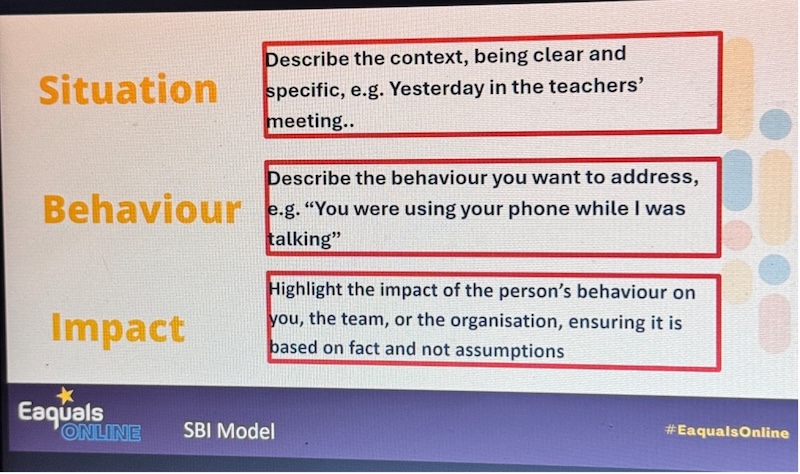
Another approach that I found particularly logical and practical was the Situation–Behaviour–Impact (SBI) model. This model involves describing the situation in which an event occurred, identifying the specific behaviour observed, and explaining its impact. It provides a structured way to give feedback without making personal judgments.
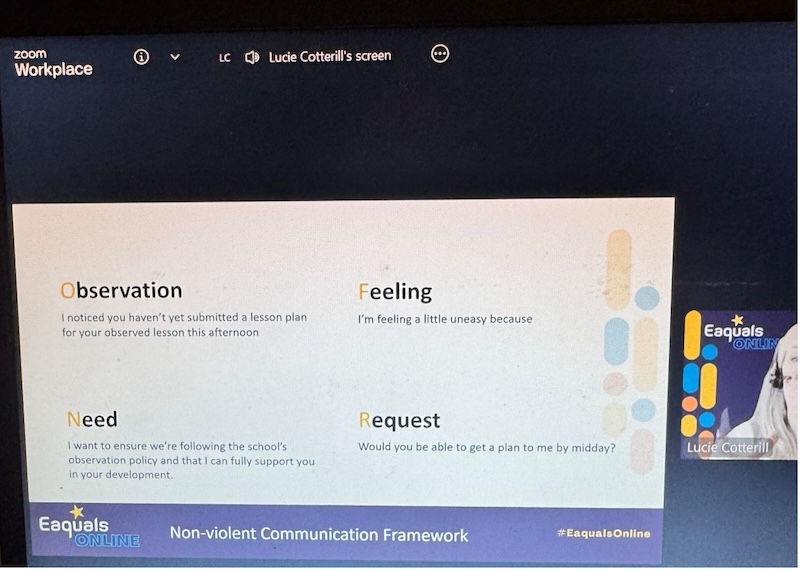
Cotterill also introduced nonviolent communication, which involves four steps: observation, feelings, needs, and requests. This approach can help both parties communicate their concerns more constructively during a conflict by focusing on what happened, how they feel, what they need, and what they would like to change. Below you may see the example.
Although certain behaviours may indicate that a person is difficult to work with, Cotterill also highlighted other factors that can influence how behaviour is perceived. Generational differences, cultural backgrounds, and differing interpretations of feedback may all contribute to misunderstandings. For this reason, she strongly recommended that managers explore candidates' previous organisational cultures and working environments during recruitment. Understanding these experiences may help them anticipate potential differences and support smoother adaptation to a new workplace.
Session 3: Beyond Borders — Practical Leadership in Multi-Country Academic Management
Similar to Cotterill, Natalia Bagdavadze emphasized the importance of understanding cultural differences in the workplace. In her session, she highlighted how communication styles and sociolinguistic practices can vary across cultures, particularly in international institutions.
Her discussion reminded me that effective communication involves more than simply exchanging information. It also requires an awareness of how people from different cultural backgrounds express themselves, interpret messages, and approach professional relationships. Recognising these differences can help leaders communicate more effectively, adapt to their employees' needs, and foster mutual understanding in multicultural working environments.
Session 4: Managing the TikTok Generation (Without Losing Your Mind!)
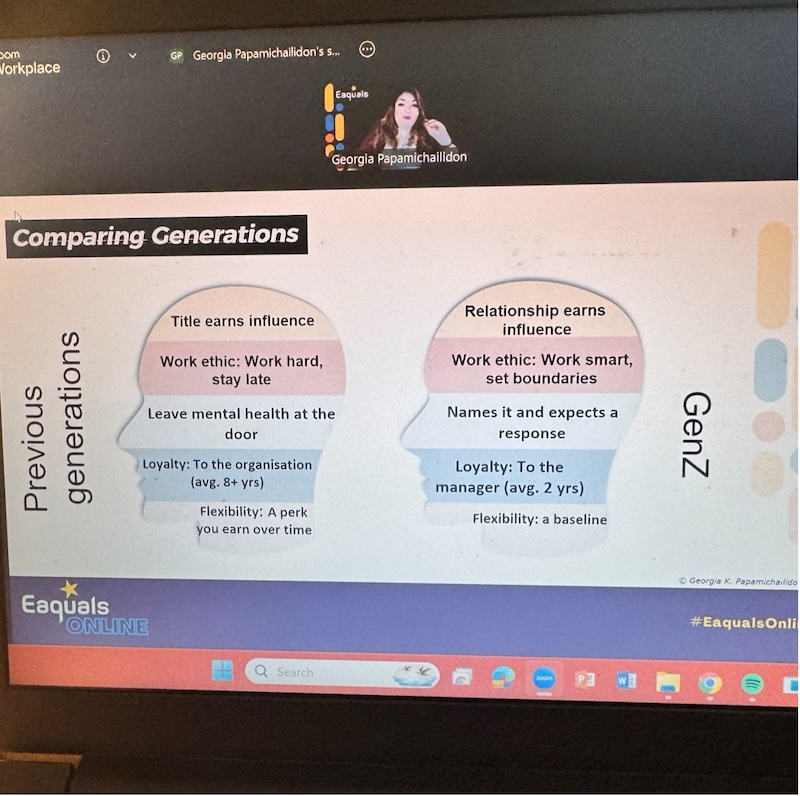
Georgia Papamichailidon’s session was another particularly interesting one, as it explored various management skills in the context of generational change. Although the discussion focused primarily on managing employees, I believe many of the ideas are equally relevant to education, particularly to the relationships between teachers and students.
Each new generation brings different expectations, communication preferences, and mindsets into the workplace. The same is true of our classrooms, where we encounter students whose attitudes towards learning, feedback, technology, and communication may differ from those of previous generations.
One suggestion that particularly caught my attention was the use of anonymous Padlet boards to give employees opportunities to ask questions or express concerns freely, without feeling uncomfortable about addressing their managers directly. I thought this approach could also be applied in our classrooms. Anonymous digital boards could allow students to share feedback, raise concerns, or ask questions they might feel hesitant to bring up during class or in face-to-face conversations.
Another interesting activity involved organising a Christmas party or a similar social event in which participants were assigned different emotional states without being told which states the others had been given. The purpose was to practise responding to different emotional reactions and develop interpersonal and management skills.
Once again, I found myself thinking about how this idea could be adapted for language teaching. Such an activity could provide an engaging opportunity for speaking practice and role-play, allowing students to practise responding to different emotions, navigating unexpected interactions, and developing their communication skills. In fact, role-play activities of this kind are already part of our teaching practice, making the suggestion particularly relevant to the classroom.
Session 5: Leading and Learning — Sustaining CPD in Academic Leadership
In Joanne Margaret Gillespie’s session, the main focus was continuous professional development (CPD) for academic leaders. The session drew heavily on leaders’ previous experiences and encouraged participants to reflect on the situations they had encountered, the decisions they had made, and the lessons they had learned.
One of the highlights of the presentation was a diagram illustrating the concept of professional learning from the work we do.
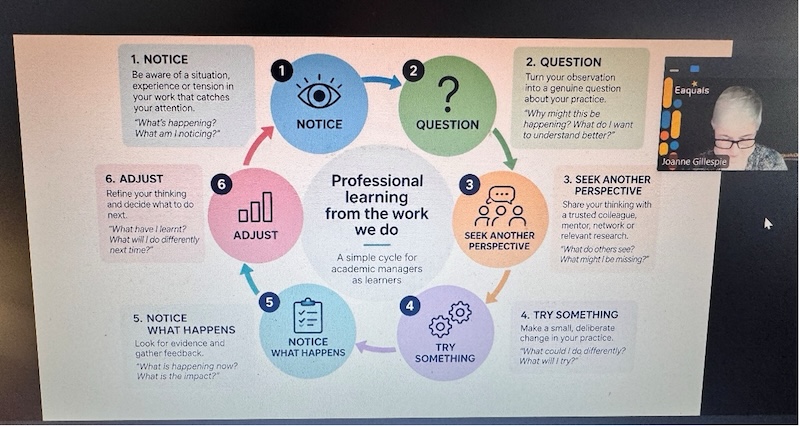
I believe this concept is equally relevant to teachers and our everyday classroom experiences. When a lesson or activity does not go as planned, we have an opportunity to learn from the experience rather than simply move on. We need to identify problems, question our assumptions, seek alternative perspectives, experiment with different approaches, observe the results, and make adjustments accordingly.
This process highlights how professional development does not take place only through formal training sessions or workshops. It can also emerge from our daily practice, provided that we take the time to reflect on our experiences and use them to inform future decisions.
Session 6: From Alternative to Gold Standard — Online English Language Teaching Professionalised
In Katherine Martinkevich’s session, the focus shifted to online English language teaching and the standards that should guide its practice. Below you may see the picture related to the standards.
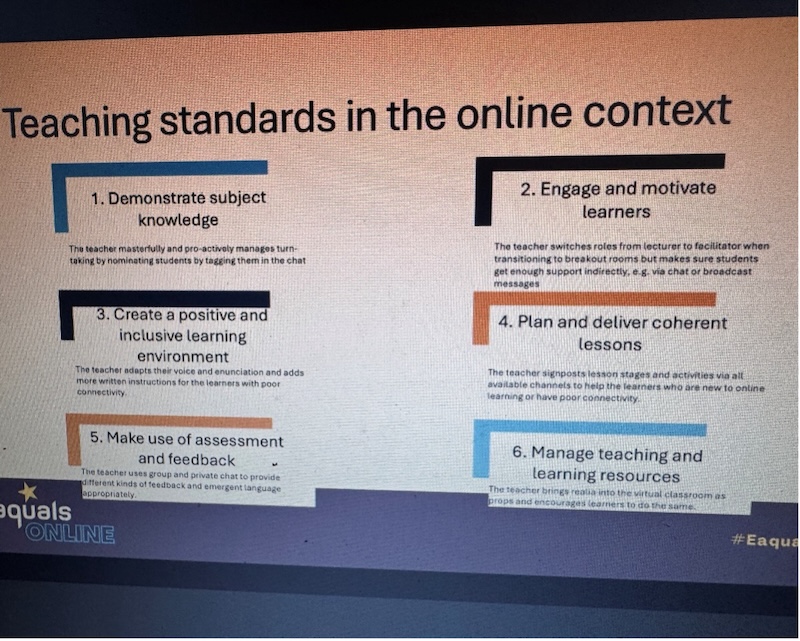
According to Martinkevich, online language teaching should not be viewed merely as a convenient alternative to face-to-face instruction. Instead, it offers unique opportunities and possibilities of its own. The field has also evolved, with an increasing emphasis on teacher development and teaching quality.
Another important point was that frameworks for teaching quality are most meaningful when they are grounded in actual teaching practices. Rather than relying solely on abstract standards, we need frameworks that reflect the realities of online classrooms and support teachers in developing effective, context-sensitive approaches to instruction.
This perspective reinforces the idea that online teaching should be recognised as a professional practice in its own right, supported by relevant standards, ongoing professional development, and a commitment to quality.
Final Reflections
Overall, the conference offered valuable insights into leadership, workplace communication, generational differences, professional development, and online language teaching. Although the sessions addressed different topics, I noticed a common thread running through many of them: the importance of understanding people, reflecting on our experiences, and adapting our practices to meet changing needs.
What I found particularly valuable was the opportunity to consider how ideas presented in a management context could be transferred to language education. Whether through creating opportunities for anonymous student feedback, using role-play to develop interpersonal skills, or learning from classroom experiences, many of the strategies discussed could be applied directly to our teaching practice.
The conference reminded me that professional growth does not happen simply by acquiring new knowledge. It also requires reflection, openness to different perspectives, and a willingness to try new approaches. These are valuable principles not only for academic leaders but also for teachers who strive to create supportive, responsive, and effective learning environments.