
From Vision to Practice: Our Key Takeaways from Eaquals Online
From Vision to Practice: Our Key Takeaways from Eaquals Online – Building Quality Foundations
by Dr. Özlem Zengin & Züleyha Tulay
This year, we were proud to participate in Eaquals Online 2025, an inspiring conference that showcased the knowledge and expertise of the Eaquals membership. The event's central theme, 'Building Quality Foundations – From Theoretical Frameworks to Practical Applications,' resonated deeply with our commitment to excellence in language education.

The conference explored how established and new frameworks can serve as powerful tools for enhancing quality across all facets of language learning and teaching. Below, we've compiled a summary of the key sessions that provided invaluable insights for academic managers, teacher trainers, and classroom practitioners.
Setting the Vision: The Council of Europe's Enduring Contribution
Sarah Breslin kicked off the conference with a plenary session titled "The Council of Europe and language education: from vision to reality; from theory to practice." She connected the Council's human-rights-based vision for language education to practical applications in policy, teacher education, and classroom practice. Emphasizing the importance of plurilingual and intercultural education, Sarah demonstrated how international cooperation projects have developed key resources to bring this vision to life for a democratic culture.
Empowering Academic Leadership: The Eaquals AMCF
A significant focus was placed on the Eaquals Academic Management Competences Framework (AMCF), presented as a crucial tool for developing leadership, curriculum, and quality assurance skills.
● Nergis Uyan elucidated the principles underlying the AMCF, detailing its development and practical implementation.
● In "From Newbie to Navigator: Developing Academic Leaders," Juliette Synnott-Lee shared a compelling case study. She illustrated how the AMCF served as a dynamic roadmap to transform an inexperienced Director of Studies into a confident academic leader through structured self-evaluation, coaching, and role-specific application.
● Donald Staub and Özge Coşkun Aysal, in "The Capability-Competency Chasm," highlighted the AMCF as a solution to the EMI (English as a Medium of Instruction) leadership gap. They shared how the School of Foreign Languages at İzmir University of Economics utilized the framework to align systems, enhance recruitment, and guide institutional change, preventing burnout among newly promoted administrative staff.
Cultivating Excellence: The Eaquals Teacher Training & Development Framework
The Eaquals Framework for Language Teacher Training and Development (TD Framework) emerged as a cornerstone for continuous professional growth.
● Sue Hackett, one of the framework's contributors, outlined its foundational principles, development, and diverse applications in supporting language teachers at all career stages.
● Vladlena Tcherkachina & Robin Foggo presented "Eaquals-Inspired Approach to MEF University SoFL Teacher Development and Training." They showcased how MEF University School of Foreign Languages successfully implemented the TD Framework to establish a structured Continuous Professional Development (CPD) system, leading to enhanced instructional practices, improved student learning, and greater institutional quality.
● In "Framework-Based AI Literacy Training for Future-Ready Pre-Service ELT Teachers," we demonstrated an innovative application. The integration of Generative AI into education has created a massive challenge for institutions: how do we ensure pre-service teachers move beyond surface-level tool use (like simply generating a text) to developing true, ethically grounded AI competency? Our presentation introduced a proven solution: framing AI literacy training within the authoritative structure of the Eaquals Framework for Teacher Development and Training (Eaquals TD Framework).
The Paradigm Shift: From Digital Skills to Professional Competence
We assert that AI proficiency is no longer a peripheral 'digital skill' but a core component of a teacher's professional competence. The Eaquals TD Framework, with its focus on knowledge, skills, and attitudes, provides the necessary blueprint to integrate this complex area.
Without a framework, AI training risks falling victim to ethical dilemmas, tool overload, and uncertainty—challenges that directly relate to the professional's core domain of 'Professional Conduct.'
Mapping AI to the Five Eaquals TD Domains
To ensure holistic development, our training sessions (which introduced tools like ChatGPT, Claude, Napkin AI, and Madlen) were meticulously mapped to the Framework’s five main domains:
1. Planning Teaching and Learning: Focused on AI-assisted design to develop skills in selecting appropriate lesson objectives and planning logical, highly differentiated sequences.
2. Teaching and Supporting Learning: Emphasized digital literacy and resource development, using AI to instantly create engaging, structured activities.
3. Assessment of Learning: Explored AI-based formative feedback to enhance accuracy and timeliness, linking directly to the Framework's mandate for transparent assessment.
4. Language, Communication and Culture: Addressed the critical use of AI to analyze authentic texts for register, connotation, and exploring intercultural communication.
5. The Teacher as Professional: This domain anchored the crucial training on prompt design (as a new technical skill) and the absolute necessity of reflective practice and ethical use to build self-assessment and teacher autonomy.
The Developmental Pathway: From Replicator to Facilitator
Crucially, the Framework allowed us to define a clear path for professional growth:
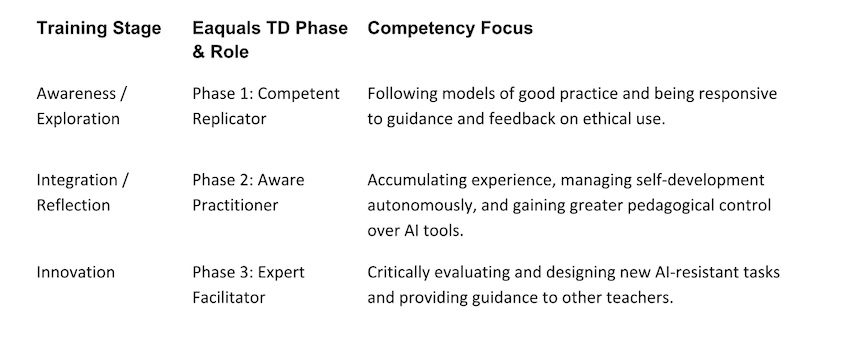
● By using the Eaquals TD Framework, we provide future educators with a structured methodology, ensuring they are prepared to teach confidently and responsibly in evolving educational contexts.
Addressing Specialized Needs: The LAP Framework
The conference also featured a dedicated session on the Eaquals Framework for Language for Academic Purposes Teacher Training & Development (LAP). This presentation examined the framework's development and provided guidance on how professionals, including teachers, managers, coordinators, and trainers, can effectively utilize it within their specific academic contexts. It was presented as an invaluable tool for supporting those working in the LAP field.
Preparing for a Sustainable Future: The Cambridge Sustainability Framework for ELT
Looking to the future, Jasmin Silver explored the Cambridge Sustainability Framework for ELT. Developed through extensive research, this framework offers a method for understanding the critical skills learners need to become informed, compassionate, and innovative agents for positive environmental, social, and economic transformation. The session also provided practical demonstrations of its application within the ELT classroom.
Deeper Insights: The Eaquals TD Framework Panel Discussion
A crucial panel discussion brought together presenters discussing the TD Framework. This session provided a platform for deeper insights into the framework's practical application and future. The panel addressed:
● Personal and Institutional Influence: How the framework shaped individual approaches to training and mentoring.
● Adaptation and Challenges: Strategies for implementing the framework and overcoming contextual challenges.
● Teacher Perception and Evaluation: Navigating the sensitivity of evaluation, emphasizing reflection over judgment.
● The Future of Quality Assurance: Projections on the framework's role in future teacher development.
● AI and CPD Integration: A central focus on integrating AI into CPD for training organization, goal setting, and teacher self-development.
Our Commitment to Quality
Eaquals Online underscored the immense value of well-structured frameworks as actionable blueprints for consistency, quality assurance, and transformative professional growth. At Sabancı University School of Languages, we are committed to integrating these insights and utilizing these powerful tools to continuously enhance our development, and ultimately, the learning experience for our students.
Stay tuned for more updates on how we are putting these foundations into practice in our AI Inset session in 2025-2026 Academic Year!
Please click here for the infographic summary.