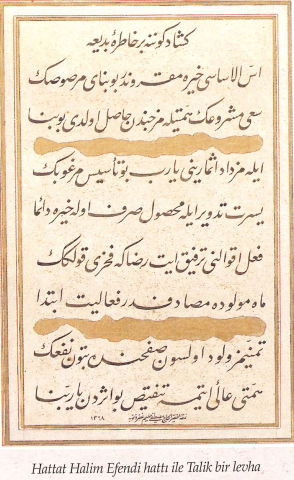
Ottoman Turkish refers to the language spoken and written by Turks living within the borders of the Ottoman Empire, or the language written during the same period containing a heavy concentration of Arabic and Persian words, or more generally, Turkish written with Arabic script. It is the written language that continued from the 13th century until the beginning of the 20th century, encompassing the first period in the development of Turkey Turkish, known as Old Anatolian Turkish.
The period spanning the 13th to 15th centuries is called the initial period, exhibiting a relatively simple structure in terms of grammatical forms and vocabulary. The period starting from the second half of the 15th century, especially with the conquest of Istanbul and the city becoming a center of culture and civilization, and continuing until the mid-19th century, is named the classical period. The Turkish society, which remained under the influence of Islamic cultural spheres and languages for centuries, began to come under the influence of Western culture with the Tanzimat reforms. Consequently, the concern to express many newly encountered concepts caused the literature of the era, in the second half of the 19th century, to move outside the framework of Divan literature and adopt a European character under the influence of Western civilization. This period, which lasted from the mid-19th century until the beginning of the 20th century, is called the renewal period.
During five centuries of history, not only literary works but also thousands of works related to every area of social life (literature, history, medicine, law, economics, religious sciences, etc.) were created in Ottoman Turkish. This situation demonstrates the academic importance of learning the written language called Ottoman Turkish, particularly in the fields of social and natural sciences. The abundance of manuscripts, due to the lack of printing technology at one time and the high cost of its use later due to the multiplicity of letter combinations, led to the use of Arabic letters in different calligraphic styles for both official and private purposes, such as sülüs, nesih, divani, rik’a, ta’lik, and siyakat. This situation necessitates the paleographic study of the written language.